By, Belayet Hossen
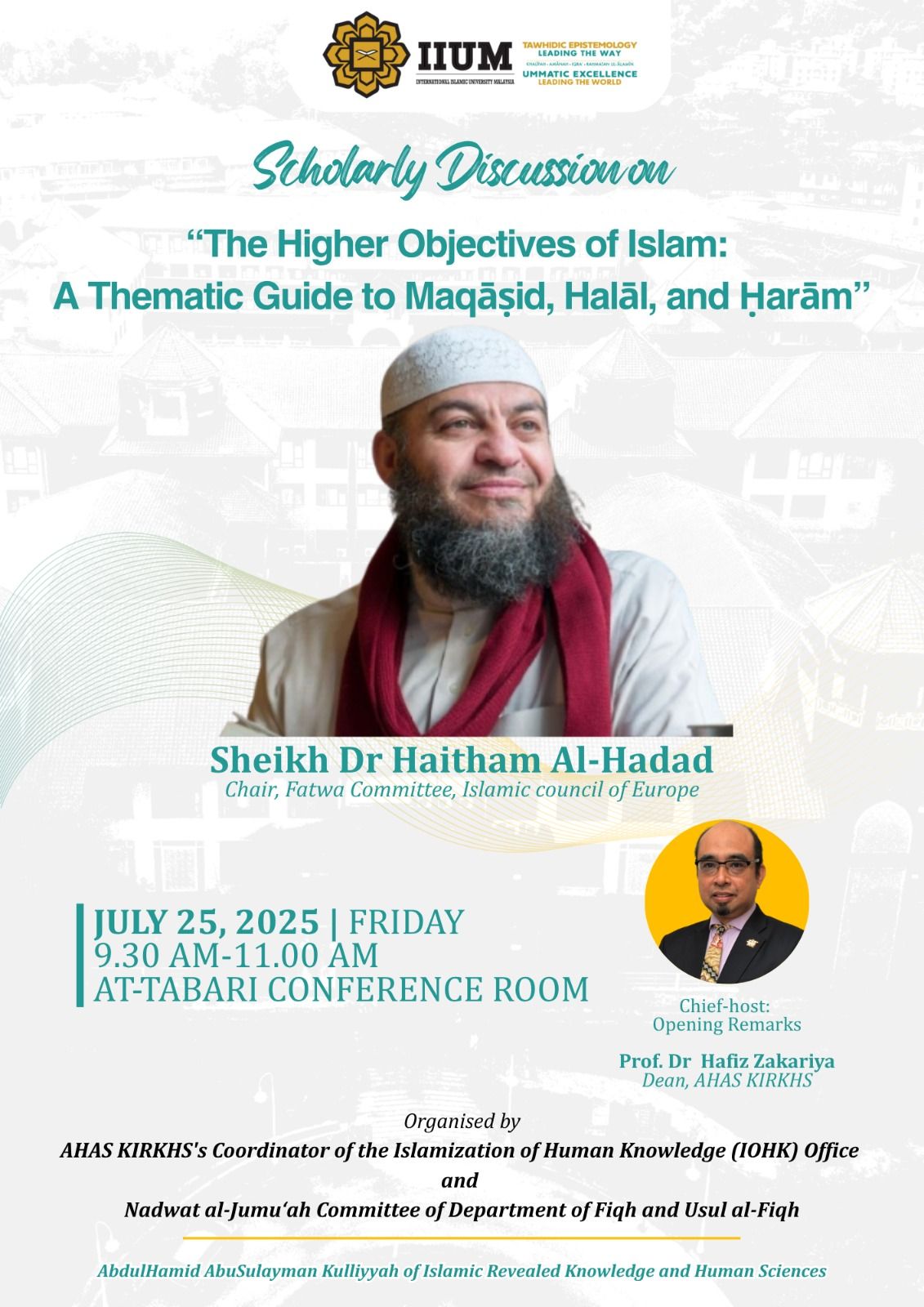
There was a wonderful scholarly discussion led by Sheikh Dr. Haitham Al-Hadad, Chair, Fatwa Committee, Islamic Council of Europe titled, “The Higher Objectives of Islam: A Thematic Guide to Maqāṣid, Halal and Haram” on 25 July 2025 at AHAS KIRKHS.
The program was honoured and officiated by Dean, AHAS KIRKHS, Professor Dr. Hafiz Zakariya, and moderated by Associate Professor Dr. Abdulhamid Mohamed Ali Zaroum, and the emcee of the program was Associate Professor Dr. Shaheed Abdullahi Busari with the closing remarks delivered by respected Head, Department of Fiqh and Usūl al-Fiqh, Associate Professor Dr. Sayyed Mohamed Muhsin.
In his welcoming speech, Professor Dr. Hafiz mentioned, “The issue of Maqāṣid al-Sharīʽah is crucial in the intellectual arena of this contemporary world. It is not only a burning issue among the scholars of Islamic world but also it created an intellectual discourse among the scholars of western world. It has become now a global issue which basically discusses the philosophy of Islamic law. Our scholars should pay more attention to the exploration of the objectives of Islam and to integrate them with all branches ofcontemporary knowledge.”
Sheikh Dr. Haitham in his lecture said, “Scholars of our Ummah should think that today what we teach our students in the name of Islamic Studies and Sharīʽah Studies at our schools, madrasahs and universities, is it conducive to rebuild our Ummah? What is the role of scholars of Ummah today, where people of Palestine are starving in lack of food and basic needs in front of entire Islamic world?”
He added, “We should not remain in the context of fourth century or fifth century of Islam to solve the current crises and problems of our Ummah. Rather, we have to study the texts written by our classical scholars from the perspective of current era. The understanding of context is significant to comprehend Islam and its practice. If we always remain stuck in the context of those classical scholars, we will never be able to solve the problems that our Ummah faces today.”
On top of that, Dr. Hadad further said, “In this case the IIUM has to come forward and take the challenge to resolve the crises that the Ummah is collectively facing everywhere around the world. It is crucial to know that the problems that we experience today, the scholars of classical period did not experience. They practiced the mutūn of their period, but we have to practice the mutūn based on our current context.”
He posed some questions to the audience in terms of Islamic Studies students as he asked, “Do we teach them management sciences? Do we teach them social sciences? Don’t they need these kinds of knowledge? Do our fuqaha know Islamic banking and finance properly? Do they have enough knowledge on this vital issue? If they do not know then how they will solve the problems of our Ummah?”
Additionally, Dr. Haitham mentioned that Islam is not a mere religion like what we see today. Rather, Islam built the greatest civilization on earth. Nevertheless, he opined that we should rethink about the notion of Maqāṣid al-Sharīʽah. The scholars of Maqāṣid al-Sharīʽah, did they truly comprehend the entire concept? What are the objectives of Islam that Allah (swt) expressed in His Quran? If we survey the Quran, we find numerous objectives of Sharīʽah for instance: Worshiping Allah alone, establishing justice on earth, testing human beings (ibtilā) and making Islam victorious over other all religions of the world etc. Did our scholars of Maqāṣid al-Sharīʽah mention these in their Maqāṣidic discourse? If the Maqāṣid al-Sharīʽah is confined only to five or more than this specific kulliyyāt then where is the Maqāṣid of justice (ʽadl)? Where is the Maqāṣid of makārim al-Akhlāq, where the Prophet (saw) said that he was sent to perfect the morality of people? And where is the discourse of Maqāṣid al-ʼAmān and Maqāṣid al-Ṭahārah?
After his lecture, there was an interactive and engaging discussion among the participants. He answered to the numerous questions coming from the participants, where faculty members, masters and PhD students were included. The active participation of audience in discussion with Dr. Haitham proves that the program was truly fruitful, mind-blowing and full of enlightenment. Many more scholars like Dr. Haitham from across the world should be invited to IIUM so that teachers and students at the university can share their gained knowledge and experiences with them and that is how they can produce new knowledge, which may benefit not only Islam and Muslims of Malaysia but also it may benefit the entire humankind.
The session was jointly organized by AHAS KIRKHS’s Coordinator of the Islamization of Human Knowledge (IOHK) Office and Nadwat al-Jumuʽah Committee of Department of Fiqh and Usul al-Fiqh, held on July 25, 2025, from 9:30 am to 12 am at al-Tabari Conference Room, Human Sciences Building, AHAS KIRKHS, IIUM Gombak.***

- Knowledge Transfer on Stingless Beekeeping and Downstream Product to Empower the Communities - August 3, 2026
- Growing Together: How IIUM and Kebun Bandar Sungai Bunus Cultivate More Than Just Green Spaces - August 3, 2026
- Khalifah Nisa’: Reclaiming Women’s Role as Guardians of Creation - August 3, 2026