By, Mohd Abbas Abdul Razak
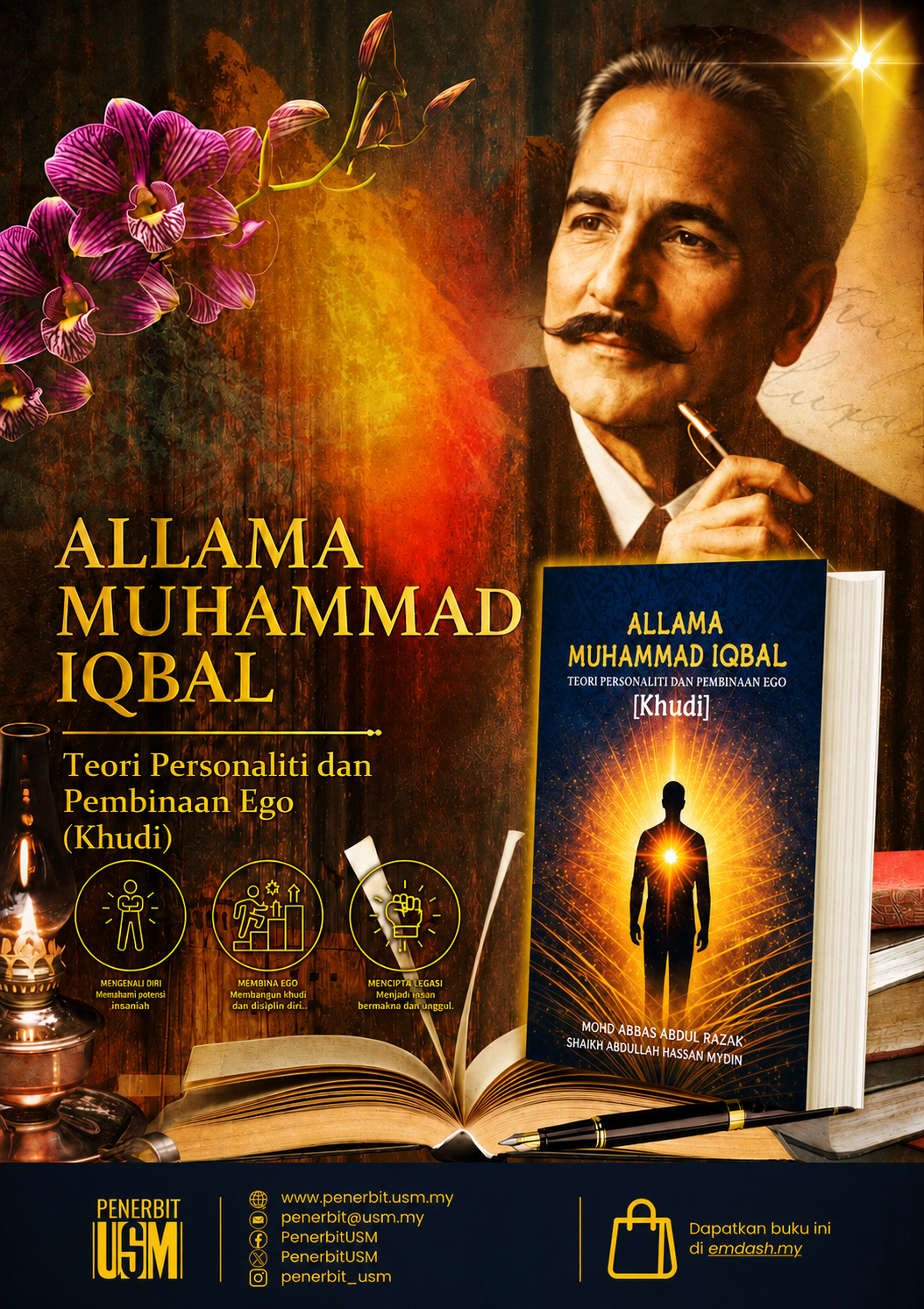
A new book on the thought of Allama Muhammad Iqbal (1877–1938) is expected to be published within the next month or two. The book is the outcome of a collaborative research project between Universiti Sains Malaysia (USM) and the International Islamic University Malaysia (IIUM). It is authored by Mohd Abbas Abdul Razak, as the principal author, and co-authored by Shaik Abdullah Hassan Mydin. The book bears the title ‘Allama Muhammad Iqbal: Teori Personaliti dan Pembinaan Ego (Khudi)’.
This scholarly work is the culmination of two years of dedicated research and writing. Throughout the project, it was meticulously monitored and supervised by Madam Nurul Asyqin Kamarun Baharen, Head of the Publication Unit at USM. With her vast experience in academic publishing, she also served as the book’s language editor, ensuring that the manuscript met high scholarly and linguistic standards.
We look forward to sharing this book with readers who are interested in the philosophy of Allama Muhammad Iqbal, particularly his ideas on personality development and the cultivation of the ego (Khudi). We hope that this work will contribute to a deeper understanding and appreciation of Iqbal’s intellectual legacy.
The original manuscript was written some three decades ago when Mohd Abbas was an undergraduate student at IAIN Ar-Raniry in Aceh, now known as Universitas Islam Negeri Ar-Raniry (UIN Ar-Raniry), Banda Aceh, Indonesia. Based entirely on library research, the Skripsi (as it is called in Indonesia) was titled Konsepsi Pendidikan Akhlaq Menurut Muhammad Iqbal.
As a graduation requirement, students are required to produce an academically written manuscript with proper citations at the end of their study programme. The most challenging part of undertaking such a research project is defending and obtaining the approval of the Viva Committee.
After receiving the endorsement of the Viva Committee at Ar-Raniry, the manuscript went into a state of hibernation for a very long time. Although this research book, which will, Insha Allah, see the light of day in the coming months, has undergone many revisions, the basic ideas of Allama Iqbal’s thought process can be traced back to its inception in Aceh.
In publishing the book in the modern era of the Internet and social media, the authors have added much new information to make it more interesting and beneficial for readers. Originally written in Bahasa Indonesia, the manuscript also underwent language adaptation to cater to the needs of readers in Malaysia, Singapore, Brunei, and, to some extent, the Malay-speaking population of Southern Thailand.
A Bird’s-Eye View of the Book
Though countless scholars and researchers throughout the world have written on the ideas of Allama Muhammad Iqbal, this book is a modest attempt by the authors to revive and bring to the attention of today’s younger generation Iqbal’s call for the Muslim Ummah to embrace the ideal way of life enshrined in the teachings of the Qur’an and the Sunnah.
To Iqbal’s critics, the authors would like to highlight the fact that many of the problems he addressed in his writings are still prevalent within the Muslim Ummah. Although the Qur’an describes the Muslims as Khayra Ummah (the Best Community), many of the challenges remain unresolved despite the efforts of numerous Muslim scholars and reformers. These include foreign domination of Muslim lands, the lack of scientific research, the persistence of a slave mentality, disunity among Muslims, weak governance, and the struggle to regain the fame and glory of the Golden Age of Islamic civilization.
In the opening chapter, the authors present a descriptive picture of the world at the time when Iqbal stepped onto the intellectual stage. It also explains the pathetic condition of the Muslim Ummah, which has lost the political will to manage its own affairs. Under the rule of Western colonial powers, Muslims were marginalized in their own lands. In addition, they were deprived economically, socially, and educationally.
All these conditions pushed many Muslims into a psychological state in which they accepted themselves as slaves and imitators of their European masters. Simply put, such a mindset created an inferiority complex, which, even after the achievement of independence, is still prevalent in many Muslim countries.
Upon explaining the condition of the world into which Iqbal was born, the authors, in the subsequent chapters, deal with a brief biographical sketch of Iqbal, the eclectic approach he used in formulating his philosophy, the concept of man from the Islamic perspective, the question of what personality is, the elements that strengthen and weaken the human personality, the ideal society in which the human personality can flourish, and, lastly, the validity of his theory from an Islamic perspective.
The Relevance of the Book
This book is particularly relevant to the younger generation. I strongly believe that the ideas presented by Allama Muhammad Iqbal through his theory of personality can play a significant role in preparing the next generation of leaders in the Muslim world. As Iqbal calls for the strengthening of the human ego (Khudi) and the rejection of self-negating philosophies that continue to prevail in some parts of the Muslim Ummah, his ideas on personality development can help Muslims break free from a mindset deeply entrenched in inferiority, low self-esteem, and superstitious beliefs. More importantly, they can liberate individuals from the self-defeating attitude of believing, “I am good for nothing.”
An understanding of Iqbal’s philosophy can restore among young people the dynamism that once characterized the Muslim Ummah and inspire them to move forward with confidence and determination. His ideas encourage them to reject fatalistic thinking and the passive acceptance of taqdīr (qismat) without making any effort to overcome poverty, ignorance, blind faith, and imitation. Instead, they inspire individuals to strive for knowledge, enlightenment, innovation, creativity, progress, and holistic development.
Finally, it is my sincere hope that those who take a deep plunge into the ocean of Iqbal’s thought will develop a stronger consciousness of the Almighty, a greater sense of responsibility towards humanity, and a deeper commitment to promoting peace, justice, and harmonious coexistence. If this book succeeds in inspiring even a small number of readers to rediscover Iqbal’s timeless vision of selfhood and purposeful living, the efforts of the authors will have been richly rewarded.***
(The views expressed are those of Dr. Mohd Abbas Abdul Razak from the Department of Fundamental and Interdisciplinary Studies, AHAS KIRKHS, IIUM, and do not necessarily reflect the views of IIUM-Today).

- Knowledge Transfer on Stingless Beekeeping and Downstream Product to Empower the Communities - August 3, 2026
- Growing Together: How IIUM and Kebun Bandar Sungai Bunus Cultivate More Than Just Green Spaces - August 3, 2026
- Khalifah Nisa’: Reclaiming Women’s Role as Guardians of Creation - August 3, 2026