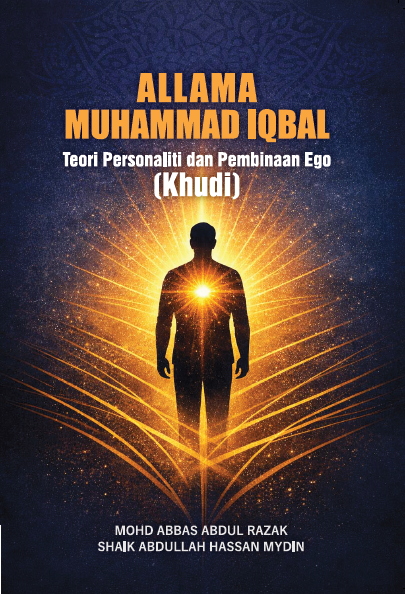
By, Mohd Abbas Abdul Razak and Shaik Abdullah Hassan Mydin
This newly published work on Allama Muhammad Iqbal (1877–1938) is a collaborative effort by academics from Universiti Sains Malaysia (USM) and the International Islamic University Malaysia (IIUM). The book explores the thought and philosophy of one of the most celebrated Muslim intellectuals of the modern era. Written in the Malay language, this humble volume seeks to engage not only the academic community but also general readers interested in Islamic thought, philosophy, and civilisation.
Unlike many philosophical works that employ highly technical language and specialized terminology, this book is written in a clear and accessible style, enabling readers from diverse backgrounds to appreciate Iqbal’s profound ideas without compromising their intellectual depth. It introduces readers to Iqbal’s life, his major ideas concerning the nature of the human being, personality development, and the evolution of the ego (Khudi). As a Muslim philosopher who emerged after the decline of the Mughal Empire in the Indian subcontinent, Iqbal not only explored the mystery of human existence but also sought to correct misconceptions about the true purpose of human life by emphasising noble values, spiritual aspirations, and enduring moral principles.
Born in Sialkot, Punjab, British India (now Pakistan), into a family of Kashmiri ancestry, Iqbal gradually rose to prominence and emerged as one of the foremost Muslim thinkers of the early twentieth century. Although his ancestors had migrated from the Kashmir Valley several generations earlier, he remained deeply conscious of his Kashmiri heritage throughout his life. A remarkably versatile scholar and leader, Iqbal distinguished himself in numerous fields, including philosophy, poetry, history, civilisation, politics, education, law, and mysticism. Witnessing the political decline of the Muslim world, together with the profound intellectual, social, and spiritual challenges confronting the Muslim Ummah, inspired him to formulate a philosophical vision aimed at its revival and renewal. His entire intellectual project, expressed through both philosophy and poetry, was firmly rooted in the two primary sources of Islam: the Qur’an and the Sunnah of Prophet Muhammad (peace be upon him). Through these sources, Iqbal communicated his ideas creatively and effectively to both scholars and the wider public. Across the Indian subcontinent, he was especially celebrated as a mystical poet who inspired self-renewal, self-awareness, and intellectual awakening. During his time, poetry recitation and public literary gatherings formed an integral part of the region’s vibrant cultural life.
Although some Sufi circles criticized certain aspects of Iqbal’s thought during his lifetime, his ideas have, from the modern period to the present day, been widely accepted by Muslims from diverse schools of thought. Few people realize that Iqbal is among the most extensively studied Muslim intellectuals in the Islamic world after Prophet Muhammad (peace be upon him). Claims by some scholars that Iqbal’s philosophy has lost its relevance in the modern age are largely unsubstantiated. Careful examination of the many challenges confronting the Muslim world today reveals that, despite achieving political independence from Western colonial rule, many Muslim societies continue to struggle with the very issues that Iqbal identified, analysed, and discussed in remarkable depth.
As a visionary scholar and leader, Iqbal strongly opposed the philosophy of self-negation, superstitious beliefs, fatalistic thinking, a slave mentality, blind imitation of the West, pseudo-mysticism (false tasawwuf), and numerous other beliefs and practices prevalent among Muslims during his time. To remedy these conditions, he developed and promoted his philosophy of the ego, known as Khudi, which emphasizes the progressive cultivation and strengthening of the human personality. This philosophy advocates the development of a positive, dynamic, creative, and spiritually grounded ego rooted in authentic Islamic values. Iqbal believed that through the practical realization of this philosophy, Muslims in the Indian subcontinent and throughout the world could restore their dignity, self-respect, and the intellectual and spiritual excellence once achieved during the Golden Age of Islam (750–1258).
Beyond his profound exploration of human nature, Iqbal maintained that the honour and dignity of Muslims depend upon a living commitment to religion and the balanced development of human character. In this regard, he regarded the Qur’an and Prophet Muhammad (peace be upon him) as the primary sources for discovering, nurturing, and developing human potential. It is equally important to note that Iqbal did not reject Western thought in its entirety. Rather, he critically examined both the strengths and weaknesses of modern Western civilization in its understanding of human nature, the meaning of life, and personality formation.
Iqbal did not merely criticize Western civilization. He also sought to demonstrate that separating religion from human life constitutes a fundamental misunderstanding of both human existence and the universe. For Iqbal, religion plays an indispensable role in understanding the true nature of humanity and in cultivating spiritually and intellectually balanced individuals. A genuine understanding of religion not only elevates human dignity but also equips individuals to confront life’s many challenges while protecting them from despair, meaninglessness, and existential crises.
It is therefore not an exaggeration to suggest that Iqbal’s thought offers valuable guidance not only to Muslim societies in the East but also potential solutions to many of the pressing challenges confronting humanity in the modern West. His harmonious approach, which emphasizes the indispensable guidance of religion while simultaneously encouraging the proactive and rational use of empirical knowledge, provides a framework for nurturing knowledgeable, ethical, and progressive individuals and societies capable of contributing to the development of a just, prosperous, and sustainable civilization.
Research on Iqbal’s writings demonstrates that he is recognized not only throughout the Muslim world but also respected in the West as an influential philosopher and intellectual. He is equally celebrated as a visionary and symbolic poet whose penetrating analyses of global social issues are accompanied by profound insights into the growing spiritual crisis of modern humanity and thoughtful proposals for addressing it.
Within the broader landscape of Islamic thought, Iqbal is widely regarded as a reformer who called Muslims to rediscover the authentic dynamic spirit embodied in the Qur’an and the Sunnah rather than embracing philosophies of self-negation or illusory forms of mysticism. Accordingly, this book examines Iqbal’s life and contributions, the condition of the Muslim Ummah during his time, the philosophy of Khudi, the hidden potential of the human ego, the relationship between the ego, God, nature, and the collective ego of society, the factors that strengthen and weaken the ego, and the characteristics of an ideal society that nurtures balanced human development.
Ultimately, the publication of this book represents a dedicated scholarly effort to introduce the philosophy and intellectual legacy of Allama Muhammad Iqbal to students, researchers, and the wider public in Malaysia, Indonesia, Singapore, Brunei, the Mindanao region of the Philippines, the Malay community in Southern Thailand, and the wider Nusantara (Malay Archipelago) region. More than simply presenting his ideas, this work invites readers to embrace Iqbal’s vision of human development, the strengthening of Khudi, and the revival of the Muslim Ummah so that it may once again contribute to the restoration of the intellectual, spiritual, moral, and civilisational excellence that once distinguished the Islamic world.***
Readers interested in obtaining a copy of the book may order it through Penerbit USM’s official online sales platform:
https://emdash.my/allama-muhammad-iqbal-teori-personaliti-dan-pembinaan-ego-khudi
Dr Mohd Abbas Abdul Razak is a Senior Lecturer in the Department of Fundamental and Inter-Disciplinary Studies, AbdulHamid AbuSulayman Kulliyyah of Islamic Revealed Knowledge and Human Sciences, International Islamic University Malaysia.
Dr Sheikh Abdullah Hassan Mydin is a former Senior Lecturer in the Department of Civilisational Studies, School of Distance Education, Universiti Sains Malaysia.

- Knowledge Transfer on Stingless Beekeeping and Downstream Product to Empower the Communities - August 3, 2026
- Growing Together: How IIUM and Kebun Bandar Sungai Bunus Cultivate More Than Just Green Spaces - August 3, 2026
- Khalifah Nisa’: Reclaiming Women’s Role as Guardians of Creation - August 3, 2026