By, Hira Mushtaq
Feminism, as a modern movement, began in the West more than a century ago, calling for women’s rights in voting, work, and equality before the law. Over the past few decades, its ideas have travelled far beyond their origin, reaching Muslim countries too, where growing numbers of women now look to Western feminism as the only language for demanding fairness and recognition.
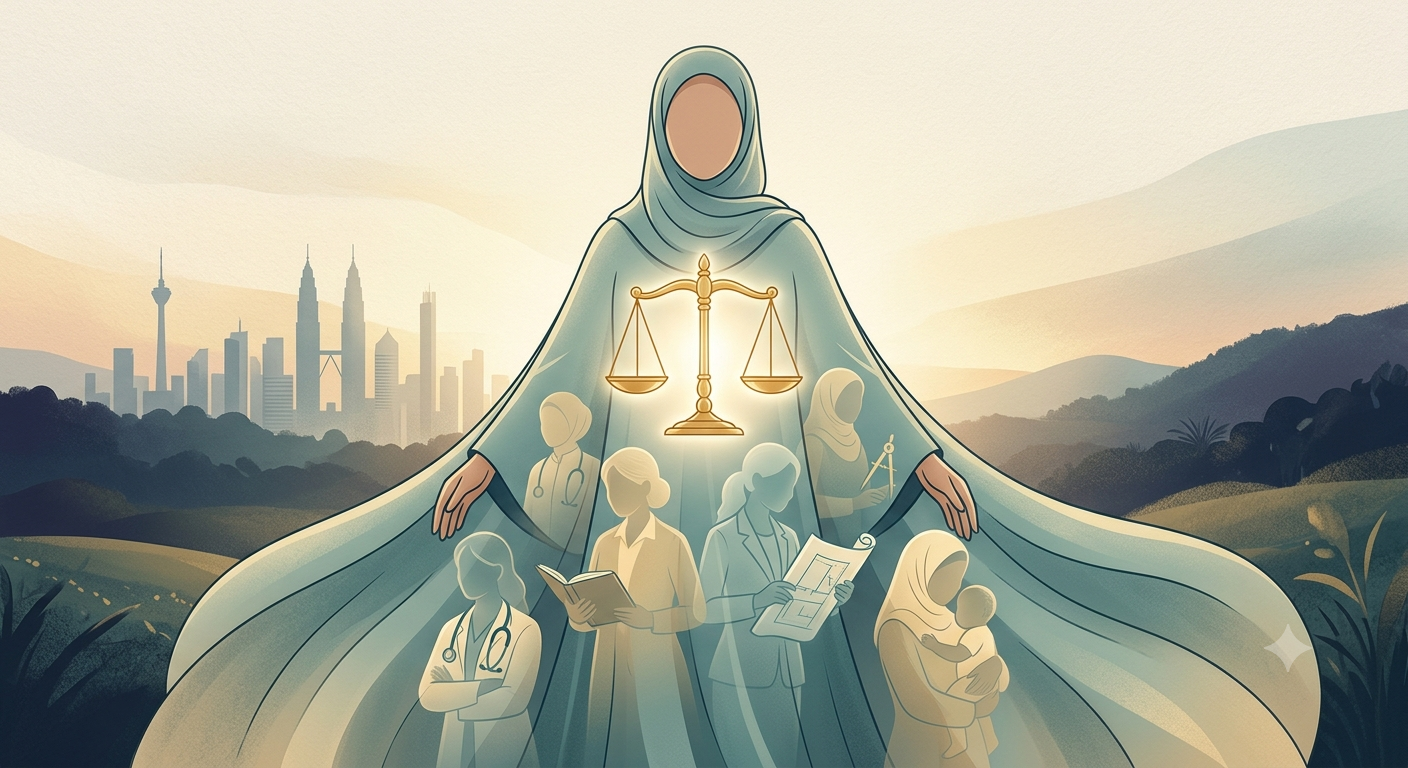
What often goes unnoticed in this shift is that Islam addressed these same questions of justice, dignity, and women’s role in society some fourteen hundred years ago. Long before the first feminist movement was named, the Quran had already established women as khalifah, stewards of Allah’s creation, equal in responsibility and worth to men. This is the idea behind Khalifah Nisa’, women’s stewardship, a framework rooted entirely in Islam’s own teachings, not borrowed from outside it.
At the heart of this idea is a concept familiar to every Muslim: khalifah or stewardship. The Quran describes all of humanity, men and women alike, as trustees of Allah’s creation, responsible for preserving mizan, the balance of the world. This role was never assigned to one gender over the other. It is shared, complementary, and rooted in justice.
A Closeness to Allah That Runs Deep
Before women led armies, businesses, or classrooms, their strength was rooted in something deeper: their closeness to Allah. The Quran holds up Maryam (AS) as a model of devotion, chosen and purified, whose worship and trust in Allah remain unmatched. Rabia al-Adawiyyah, the great mystic of Basra, taught generations that true worship comes from love of Allah alone, not fear of punishment or hope of reward. Fatimah al-Zahra (RA), the Prophet’s beloved daughter, is remembered for her humility, her nightly prayers, and her patience through hardship. This spiritual foundation is what gave Muslim women the strength to lead, to fight, to build, and to teach, without ever losing sight of who they served first.
Women Who Shaped Every Field of Life
History shows that Muslim women were never confined to one role. A few lines are enough to see how wide their impact truly was:
- Khadijah (RA) built one of Makkah’s most respected trading businesses and later funded the earliest Muslim community.
- Nusaybah bint Ka’ab picked up a sword to shield the Prophet (PBUH) at the Battle of Uhud.
- Aisha (RA) became one of the greatest scholars of Hadith and law, teaching companions and successors alike.
- Fatima al-Fihri used her inheritance to found one of the world’s oldest universities, in Fez.
- Shifa bint Abdullah oversaw market regulation in Medina and was trusted for her knowledge of medicine.
- Zainab bint Ali (RA) carried the message of Karbala forward with her courage and powerful speech.
- Umm Salamah (RA) offered political counsel that helped resolve the Treaty of Hudaybiyyah.
- Asma bint Abi Bakr braved danger to support the Prophet’s migration to Madinah.
- Khawlah bint al-Azwar led troops and fought alongside men in early Islamic battles.
- Zubaidah bint Ja’far funded wells and canals along the pilgrim route to Makkah, easing hardship for generations of travellers.
- Sutayta al-Mahamli was recognised in her time as a skilled mathematician.
- Maryam al-Ijliya designed astronomical instruments used by scholars of her era.
Business, warfare, scholarship, politics, philanthropy, science. Muslim women were present and leading in every one of them.
The same spirit continues today, in Muslim women scientists, lawyers, and community leaders across the world, many of whom draw quietly on these same Islamic values of justice and stewardship.
Care for the Earth fits naturally into this picture too. Islamic teaching frames the environment, its balance, its resources, its wellbeing, as part of the same amanah, or trust, that governs how people are meant to treat one another. Women’s historical roles as caregivers and community builders sit comfortably within this wider understanding of khalifah.
None of this dismisses the real concerns raised by modern feminist movements. Issues of inequality and injustice are real and worth taking seriously. The difference lies in the foundation. Where secular narratives often centre individual autonomy, Khalifah Nisa’ centres faith, shared responsibility, and a closeness to Allah that gives meaning to every role a woman chooses to carry.
If Islam gave women this standing so long ago, the question worth asking is why so many Muslim women today do not know it. Part of the answer lies with those meant to teach it. Contemporary religious scholars rarely speak of Khadijah’s business, Nusaybah’s courage, or Shifa’s public service from the minbar during Friday khutbahs, and these examples are largely absent from the syllabi taught in madrasas as well. When khalifah is discussed only as a general concept and never illustrated through the women who lived it, women are left without the very examples that could show them their place in Islam.
Reviving this understanding is more than an academic exercise. It is an invitation, to khateebs and teachers as much as to Muslim women themselves, to bring these names back into khutbahs, classrooms, and everyday conversation. Textbooks in business, history, science, medicine, and politics rarely mention a Khadijah, a Shifa bint Abdullah, or a Sutayta al-Mahamli alongside the other pioneers of their fields. Including these examples, subject by subject and khutbah by khutbah, would let Muslim women see clearly, from an early age, that Islam has always supported their place in every sphere of life, not as an exception, and not as something to be borrowed from the West, but as a tradition that was theirs from the very beginning.***
Hira Mushtaq is a research scholar from department of Usul al-Din, Comparative Religion, and Philosophy, AHAS KIRKHS, IIUM.

- Knowledge Transfer on Stingless Beekeeping and Downstream Product to Empower the Communities - August 3, 2026
- Growing Together: How IIUM and Kebun Bandar Sungai Bunus Cultivate More Than Just Green Spaces - August 3, 2026
- Khalifah Nisa’: Reclaiming Women’s Role as Guardians of Creation - August 3, 2026