By, Md Maruf Hasan
“I saw the best minds of my generation destroyed by madness, starving hysterical naked,
dragging themselves through the negro streets at dawn looking for an angry fix,
….
who bared their brains to Heaven under the El and saw Mohammedan angels staggering on tenement roofs illuminated,
who passed through universities with radiant cool eyes hallucinating Arkansas and Blake-light tragedy among the scholars of war,
who were expelled from the academies for crazy & publishing obscene odes on the windows of the skull,”
— Allen Ginsberg, “Howl”
Today is Friday, 10 October 2025. After the Jummah prayer, the campus is hosting a program titled “Solidarity with Palestine.” The Ummah continues to suffer — physically, emotionally, and intellectually. Amid this struggle, one philosophical issue keeps resurfacing — the problem of evil. From Gautama Buddha to Arthur Schopenhauer, thinkers have wrestled with it for centuries.
Last night, after praying at the IIUM Central Mosque, I met a 21-year-old Malaysian student from AIKOL. I knew him from the IIUM Debate Club. As I told him I was completing my PhD journey, he asked about my research area. When I mentioned that I was studying apostasy among Muslim youths, he immediately became interested and asked to continue the conversation after prayer.
After Isha, we sat and talked for nearly four hours. To my surprise, he revealed that he had identified as an atheist since the age of 15. He grew up in an Islamic school in Terengganu and had read widely in Western literature. His atheism, however, seemed deeply connected to the problem of evil.
As a researcher working on New Atheism, I understand the difference between classical atheism and this newer form. Yet, addressing each individual case is challenging, as the causes behind youthful disbelief vary widely. Many of these young people, emotionally burdened and intellectually curious, are exposed to distorted narratives from online secular sources. Often, they remain silent out of fear that their teachers or families will not understand them.
One of his main complaints was that “Allah is not merciful.” He criticized what he saw as the state’s enforcement of a narrow religious interpretation that marginalizes other Islamic perspectives. Listening to him, I realized that much of this skepticism arises not from rebellion, but from emotional confusion.
The issue of atheism and agnosticism is not unique to Muslim societies — the Christian West has grappled with it for centuries. My research suggests one key solution for Muslim-majority nations: a comprehensive Islamization of the education system, from schools to universities.
The most practical starting point is simple — teach the Qur’an in local languages at all educational levels. When Muslim youths encounter Western criticisms or the arguments of ex-Muslims, familiarity with the Qur’an empowers them to form their own judgments. The Qur’an engages readers inquisitively, addressing existence, morality, and purpose in a dialogue that transcends time.
Over 1,400 years, countless tafsirs (interpretations) have been written. Each reflects the understanding of its era, yet interpretations may evolve as human knowledge grows. This is not the Qur’an’s fault but a reflection of human limitation. Continuous engagement with the Qur’an, however, grounds a believer against confusion and misguidance.
For example, when the student raised concerns about Islam’s strict punishments, I invited him to consider the role of law in society. Even secular nations enforce severe penalties — Singapore’s death sentence for drug trafficking, for instance, is not religiously motivated but socially pragmatic. Similarly, Islamic law balances justice and compassion. During the time of Caliph ʿUmar (RA), hudud punishments were suspended in times of famine, as enforcing them would have been unjust when people were starving.
Atheism, then, is often less about philosophy and more about misinterpretation — both emotional and intellectual. Islam, in its essence, nurtures a process of understanding and submission to Allah, the Ultimate Reality.
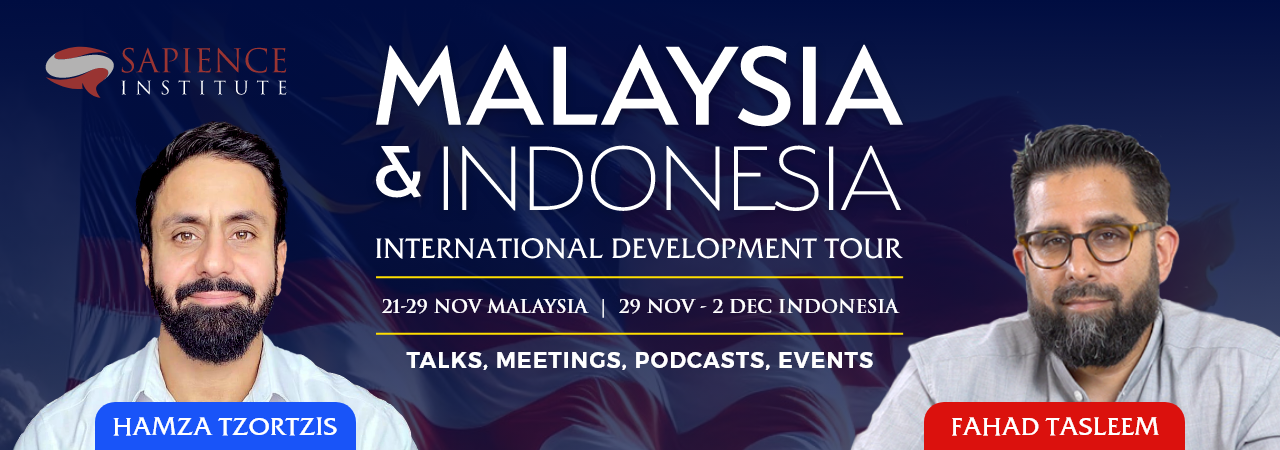
In this regard, I also encourage readers to explore the work of Sapience Institute, a London-based dawah and intellectual outreach organization known for engaging with atheism and secular worldviews through rational and philosophical arguments. The institute focuses on training Muslims to intellectually defend Islam in the modern age. Excitingly, a branch of Sapience Institute is expected to open in Malaysia soon, which will hopefully provide valuable resources for Muslim youths seeking deeper understanding.
As our conversation ended, I advised the young student not to define himself as an atheist just yet. Instead, I encouraged him to keep reading, questioning, and seeking. Faith, after all, is not an instant revelation but a continuous journey of discovery.
I do encourage to visit Sapiens Website for further research and information: https://www.sapienceinstitute.org/malaysiaindonesia/?b=1760068865097 ***

- Knowledge Transfer on Stingless Beekeeping and Downstream Product to Empower the Communities - August 3, 2026
- Growing Together: How IIUM and Kebun Bandar Sungai Bunus Cultivate More Than Just Green Spaces - August 3, 2026
- Khalifah Nisa’: Reclaiming Women’s Role as Guardians of Creation - August 3, 2026