By, Musfirah Mohamad
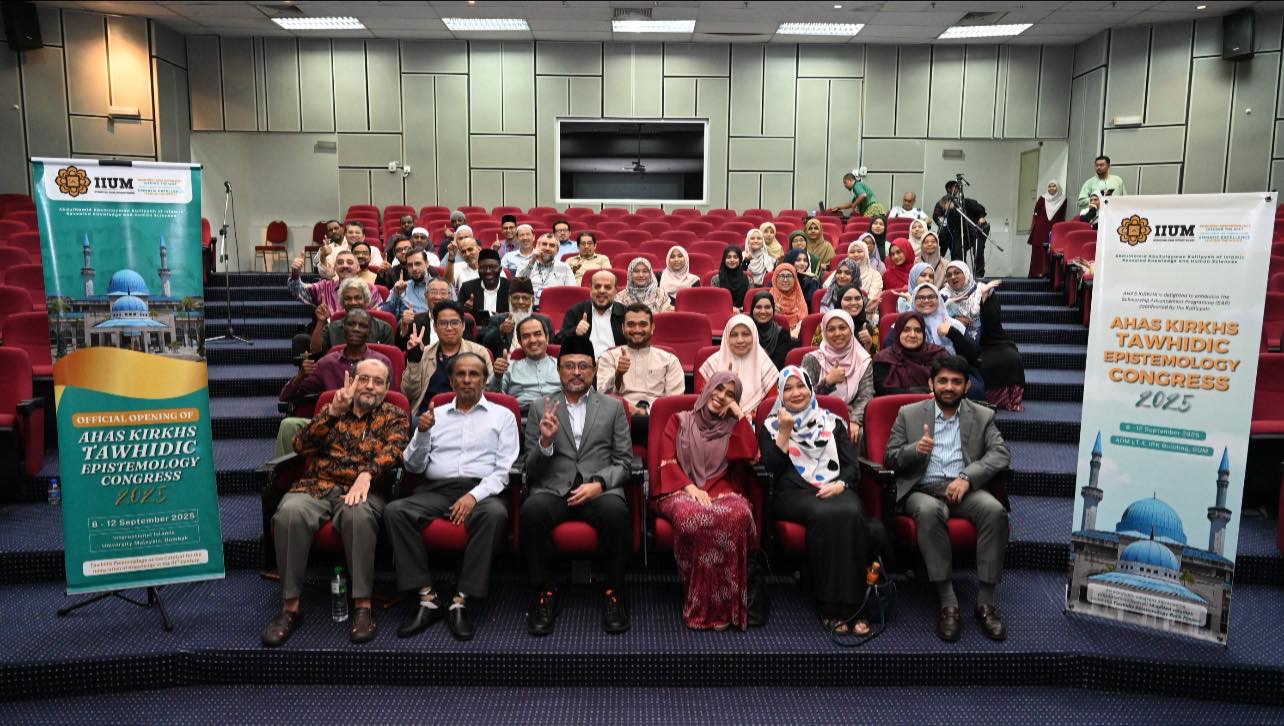
The Tawhidic Epistemology Congress 2025, organized by the AbdulHamid AbuSulayman Kulliyyah of Islamic Revealed Knowledge and Human Sciences (AHAS IRKHS), was held from 8 to 11 September 2025 at the International Islamic University Malaysia (IIUM).
Throughout the congress, more than 60 presenters from various departments within AHAS IRKHS participated, contributing diverse perspectives and research findings on Tawhidic epistemology. The congress was not convened merely to please the administration or to fulfil institutional requirements, but rather to revive and strengthen the spirit of Tawhidic epistemology within academic discourse, encouraging critical and meaningful engagement among scholars.
The closing ceremony began with a recitation of duʿāʾ by Dr. Saheed Abdullahi Busari, which set a serene and reflective tone for the event. This was followed by an insightful address by Prof. Dr. Mohamed El Tahir El Mesawi from the Department of Fiqh and Uṣūl al-Fiqh, who delivered a profound reflection on the role of Tawhidic epistemology in the contemporary academic and spiritual landscape.
In his closing remarks, Prof. Dr. El Mesawi highlighted that several prominent scholars from the Malay Archipelago—such as Hamzah Fansuri, Syamsuddin al-Sumatrani, and Abdul Rauf al-Singkel—played a foundational role in shaping the intellectual heritage of Tawhidic epistemology. He emphasised that this epistemology emerged as a response to people’s detachment from God, as many have become preoccupied with worldly ‘gods’ such as wealth, power, and status, thereby neglecting the divine essence that should guide their lives. He further reminded the audience that human beings are not defined solely by their physical bodies, but also by their intellectual and spiritual dimensions, and that a holistic understanding of the human self is central to Tawhidic epistemology.
Before the session concluded, Rabiah Tul Adawiyah Mohamed Salleh delivered a comprehensive summary of the discussions and presentations held throughout the four-day congress, allowing participants to appreciate the breadth and depth of knowledge that had been shared. One of the key strengths of this congress was its intergenerational exchange of ideas: junior lecturers and emerging scholars had the opportunity to learn from experienced senior academics, gaining valuable guidance on how to enhance their research, while senior lecturers engaged actively by offering constructive feedback, sharing their expertise, and encouraging critical dialogue, thereby enriching the overall academic atmosphere.
The closing ceremony marked not just the end of a congress, but the beginning of a renewed commitment among AHAS IRKHS scholars to uphold the understanding that Tawhidic epistemology does not merely emphasise knowledge, but also nurtures the spiritual and intellectual dimensions of human beings. It stresses the importance of translating meanings and values into real-life practice.
Musfirah Mohamad is a postgraduate student from Department of Arabic Language and Literature.***

- Knowledge Transfer on Stingless Beekeeping and Downstream Product to Empower the Communities - August 3, 2026
- Growing Together: How IIUM and Kebun Bandar Sungai Bunus Cultivate More Than Just Green Spaces - August 3, 2026
- Khalifah Nisa’: Reclaiming Women’s Role as Guardians of Creation - August 3, 2026