By, Belayet Hossen
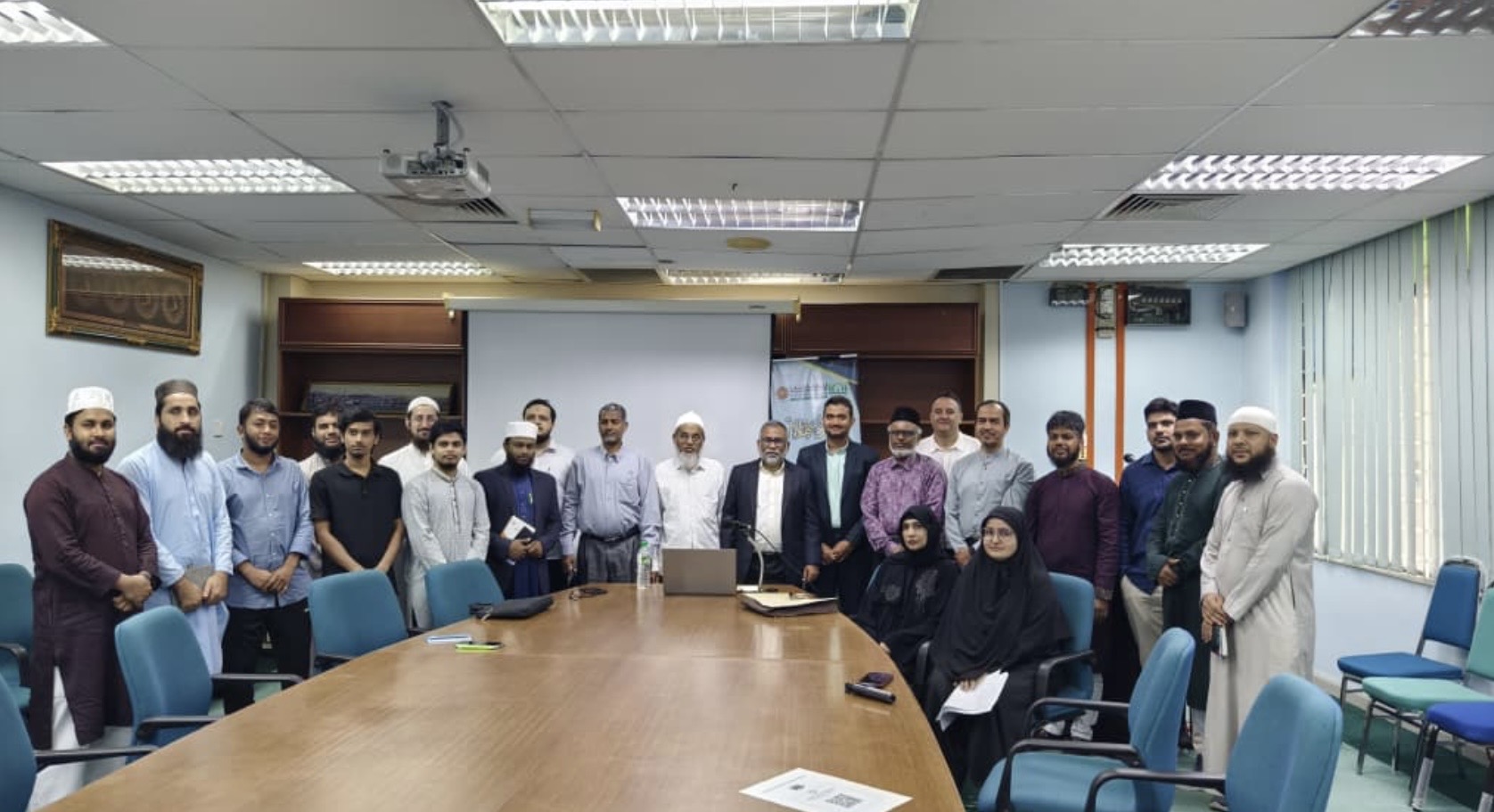
It was purely an academic and scholarly program, held from 2:00 PM to 4:00 PM on September 17, 2025, at the Al-Shafi Conference Room, IRK Building, International Islamic University Malaysia (IIUM). The lecture was delivered by Professor Dr. Nakib Muhammad Nasrullah, Honourable Vice Chancellor of the Islamic University of Kushtia and former Dean of the Faculty of Law, University of Dhaka, Bangladesh. This article outlines several key points extracted from hisdelivered lecture.
During the lecture, Professor Nakib emphasized that Bangladesh is a Muslim-majority country, where Shariah law is applied only in limited sectors such as marriage, divorce, maintenance, guardianship, inheritance, will and waqf. In these areas, researchers and intellectuals have identified fewflaws and irregularities through rigorous study. These flaws and irregularities should be brought to the attention of the government for necessary amendments or reformation, which are urgently needed in the current national context. Matters that contradict Shariah law must be addressed to preserve the integrity of its application.
Furthermore, Professor Nakib explained that the practice of Shariah law in Bangladesh, under the guise of statutory law, formulated during the British colonial period. Although this era was succeeded by the Pakistan period—largely under Muslim leadership—the Muslim communities in Bangladesh did not fully benefit from Shariah law as it was needed. Islamic law has been systematically marginalized and confined to some specific sectors by the state mechanisms, while the majority of legal domains remain governed by conventional law. This limited application is insufficient to curb crime rates and address various forms of injustice and discrimination in society.
In response to a question regarding the establishment of a Shariah court in Bangladesh, Professor Nakib stated that likeIslamic banks and other public Islamic institutions, a Shariah court could be established if there is a strong demand from the Muslim leaderships and communities. It is incumbent upon the people to advocate for its establishment by following appropriate procedures and presenting a compelling case to the government regarding its necessity and benefits.
Should a Shariah court be established, it could offer multifaceted benefits. Shariah graduates from universities and madrasahs—whether following the Qawmi or Alia syllabus—could be appointed as judges, advocates, and legal consultants. Moreover, the public could receive judicial services more efficiently, alleviating the delays caused by the overwhelming caseloads in conventional courts.
In conclusion, Professor Nakib suggested that Bangladeshcould draw upon the experiences of other Muslim countries,where Shariah courts are being operated successfully alongside conventional courts, such as Malaysia, Pakistan, Iran, Indonesia and Saudi Arabia etc. To advance this initiative, as a PhD Candidate, I (the writer) would like to suggest that the government should consider foundational steps, including the establishment of relevant academic departments in public and private universities. Proposed departments include the Department of Fiqh and Usul al-Fiqh, Department of Shariah Law, Department of Islamic Banking and Finance, and Department of Halal Industry.
The creation of these departments would enable the swift development of qualified scholars, experts, and policymakers with a Shariah-oriented background. These academic units could support the government in producing competent Shariah scholars for Islamic banking and finance, consultants for various sectors, and legal professionals for the proposed Shariah court.
The program was highly interactive and intellectually stimulating, with a remarkable turnout of master’s and PhD students from various departments of the university. Participants greatly benefited from the ideas and insightsdelivered by the distinguished speaker and other experts.
The program commenced with a welcoming speech by Associate Professor Dr. Sayyed Mohamed Muhsin, esteemed Head, Department of Fiqh and Usul al-Fiqh, AHAS KIRKHS, IIUM. The session was moderated by Associate Professor Dr. Noor Mohammed Osmani from Department of Quran and Sunnah Studies, IIUM. Among the distinguished participants, there were Professor Dr. Muhammad Amanullah, Associate Professor Dr. Abdulhamid Mohamed Ali Zaroum, and Assistant Professor Dr. Zulqernain Haider, from Department of Fiqh and Usul al-Fiqh, IIUM.***
Belayet Hossen is a PhD candidate from the Department of Fiqh and Usul al-Fiqh, AHAS KIRKHS, IIUM.

- Knowledge Transfer on Stingless Beekeeping and Downstream Product to Empower the Communities - August 3, 2026
- Growing Together: How IIUM and Kebun Bandar Sungai Bunus Cultivate More Than Just Green Spaces - August 3, 2026
- Khalifah Nisa’: Reclaiming Women’s Role as Guardians of Creation - August 3, 2026