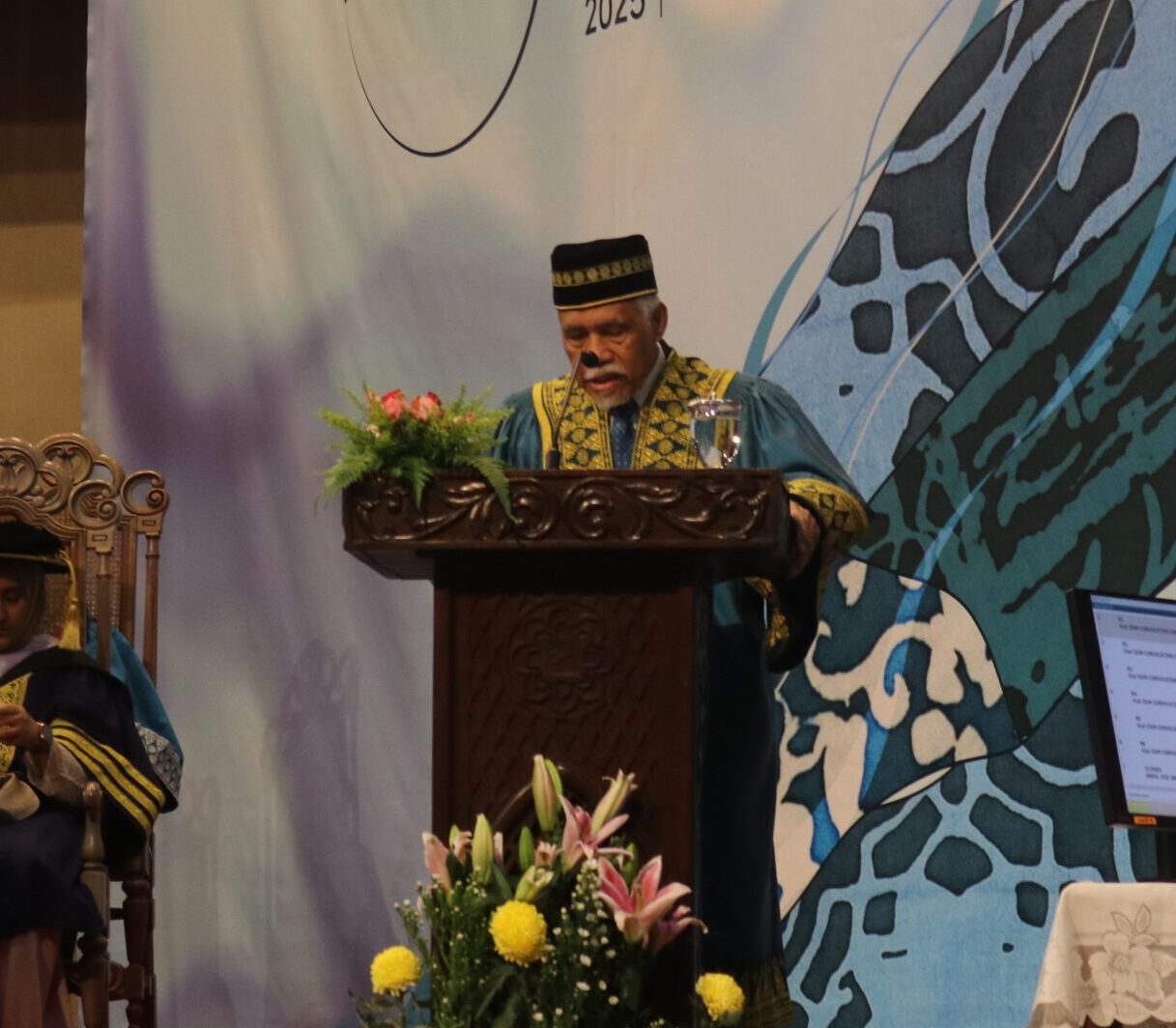
Bismillāhir-Raḥmānir-Raḥīm, al-ḥamdu lillāhi rabbil-ʿālamīn, waṣ-ṣalātu wa-s-salāmu ʿalā ashrafil-anbiyā’i wal-mursalīn, wa ʿalā ālihi wa ṣaḥbihi ajmaʿīn,.
Assalamualaikum warahmatullahi wabarakatuh, and a very good afternoon.
Honourable Professor Dr. Samsul Draman, Representative of Senate for IIUM Board of Governors, Respected University Management Committee and Senate Members, Yang Arif Datuk Dr. Arik Sanusi Yeop Johari, the High Court Judge of Kuala Lumpur. Distinguished guests, parents and guardians of the 41st IIUM Convocation Ceremony, members of the media, ladies and gentlemen.
On behalf of IIUM, I welcome you all to this afternoon’s convocation ceremony, the third day and fifth session where we celebrate the success of our Builders of Tomorrow. I would like to congratulate all graduates on your success. Please join me in congratulating our graduates.
Ladies and gentlemen, the Quran reminds us, the meaning of the verse, “It is He who made the earth tame for you. So walk among slopes and eat of His provision,” Surah An-Nur, verse 15. This verse speaks to humanity’s calling as active participants in shaping our world using the resources Allah has provided with wisdom and gratitude.
Among you today are 415 engineering and 236 graduates in architecture and environmental design. Today, we honour 654 graduates who have prepared themselves to be exactly such participants, engineers who harness natural laws to solve problems and architects who shape the spaces in which human life unfolds. This afternoon’s ceremony celebrates two professions united by a fundamental purpose that is the transformation of ideas into reality for a better and meaningful life.
What connects engineering and architecture is more than shared technical knowledge. It is a shared responsibility for the physical world we inhabit and the future world we are creating. Every bridge, every building, every system you design will outlast you and it should be every choice you make about materials, methods and purposes will echo into the future.
You are quite literally the builders of civilisation and to our engineers and architects, please remember that these are two of the activities that Allah loves the most because Allah himself is an engineer and is an architect. The separation between religious and secular knowledge is a false dichotomy that IIUM reject through its commitment to Tawhidic epistemology.
For our graduates gathered here, this integration means several things. Hence may happen in various forms. To our engineering graduates, you stand at the threshold of perhaps the most consequential error in the history of your profession. The challenges confronting humanity today demand engineering solutions at unprecedented scale and sophistication. Infrastructure-wise, Malaysia and the region face massive needs as populations grow and urbanise.
Transportation systems must be expanded while reducing carbon emissions, energy grids must be transformed from fossil fuel dependence to renewable sources, water and sanitation systems must reach unserved communities, digital infrastructure must bridge the connectivity gap between urban and rural areas. These are not abstract future concerns; these are present realities requiring your expertise now.
In terms of sustainability, climate change is not a political debate for engineers. It is a design constraint; every system you engineer, every process you optimise, every material you specify has environmental implications that compound globally. Malaysia’s vulnerability to flooding, South Asia’s exposure to rising sea levels, the ummah’s presence in regions facing water scarcity and extreme heat.
These realities demand that you practice engineering not as exploitation of nature, but in harmony with it. Green engineering, secular economic principles, bio-mimicry, regenerative design, these are not speciality niches but fundamental approaches you must integrate into everything you do. The engineering disciplines are diverse, civil, electrical, mechanical, chemical, computer, electronics and so on.
But all share common ground, you are problem solvers trained in systematic thinking, quantitative analysis and iterative design. You understand that failure is not shameful, but informative. That complexity can be managed through decomposition and modelling. Those constraints often spark innovation rather than demand. Whether you work in manufacturing, construction, technology companies, consultancies, research institutions, or public service, remember that engineering is fundamentally about service. You serve communities by providing clean water. You serve economies by enabling transportation. You serve future generations by building systems that endure, never losing sight of who you serve and why you serve .
To our architecture and environmental design graduates, Tawhidic epistemology also has several connotations. You enter a profession that is simultaneously art, science and social commentary. While engineers often work with invisible electrical currents, data flows, and chemical processes. You work with the visible and the experiential. Your designs shape how people live, work, worship, learn and interact with one another.
Architecture has been called frozen music, but it’s also frozen values. Every building makes an argument about what matters. People live, work, worship, learn and interact with one another. A structure that welcomes all bodies communicates inclusion; a space that fosters community gathering communicates collectivism, a design that honours vernacular tradition, communicates respect, communicates respect for heritage, a form that integrates nature, communicates environmental consciousness. You will make these arguments in concrete, steel, glass and timber and those arguments will endure for decades, even centuries.
Ladies and gentlemen, and so dear graduates, Southeast Asian architecture faces distinctive challenges and opportunities. Our tropical climate demands designs that manage heat and humidity while minimising energy use. Our cultural diversity requires spaces that respect varied traditions of privacy, gender interaction and sacred space. Our rapid urbanisation demands affordable housing solutions that provide dignity, not merely shelter. Our environmental vulnerability requires resilience to flooding, earthquakes and storms. Our heritage of beautiful traditional architecture.
From Malay kampung houses to Javanese joglo to Islamic mosques, they offer principles of sustainability, community and aesthetics that should inform contemporary design. Your challenge is to practice architecture as social justice, designing not just for wealthy clients, but for those who need good design most. Creating beauty that is accessible rather than exclusive, shaping cities that bring people together rather than separate them.
The Prophet Muhammad, peace be upon him, said, “If the hour is about to be established and one of you has a palm sprout in the sand, if he is able to plant it before the hour is established, let him plant it”. So, even facing the end of the world, we are to continue building, planting, creating because the world itself matters, because we serve purposes beyond immediate outcomes, because we are accountable for effort, not just result.
Climate change is the ultimate test of intergenerational responsibility. What we call sustainability; the carbon emissions from projects you design today will warm the planet for decades. The resource extraction for materials you specify will impact ecosystems permanently, the waste from construction processes will persist for generations, but conversely, the sustainable systems you engineer will prevent future emissions.
The resilient buildings you design will protect future communities, and the regenerative approaches you champion will heal rather than harm. You must become engineers and architects who think in generational time, who design for centuries rather than quarters, who measure success not just by immediate function but by long-term flourishing.
Tuan-tuan dan puan-puan sekalian, sebelum saya menutup ucapan ini, saya ingin merakamkan penghargaan kepada ahli keluarga graduan yang telah menjadikan kejayaan hari ini sebuah realiti. Para ibu bapa dan penjaga yang sentiasa ada untuk anak-anak, saya yakin ada ketikanya anda terpaksa mengorbankan keselesaan diri demi masa depan anak-anak anda.
Begitu juga ahli keluarga yang terus memberi dorongan sepanjang graduan berjuang untuk menamatkan pengajian. Pelaburan anda dalam pendidikan anak-anak adalah pelaburan terhadap keupayaan umat untuk membina, mencipta dan menyelesaikan masalah. Semoga Allah SWT melipat gandakan pengajian anda dan kurniakan kebahagiaan ketika menyaksikan hasil daripada pelaburan tersebut berjaya.
Para graduan saya harap anda tidak akan pernah lupa jasa dan pengorbanan insan-insan tersayang yang tetap percaya kepada kemampuan anda di saat anda sendiri. Mungkin tidak percaya pada diri sendiri. Tahniah kepada para ibu bapa.
Dear graduands, the ummah needs your skills, and your conscience and future generations need you to build wisely, for they will inhabit what you create. May Allah swt grant you success in all your work inspire you with creative solutions to humanity’s challenges. Make your projects sources of ongoing profit and count your professional efforts as acts of worship, Ibadah, bringing you closer to Him.
Wabillahi taufiq wal hidayah, wassalamualaikum warahmatullahi wabarakatuh.***
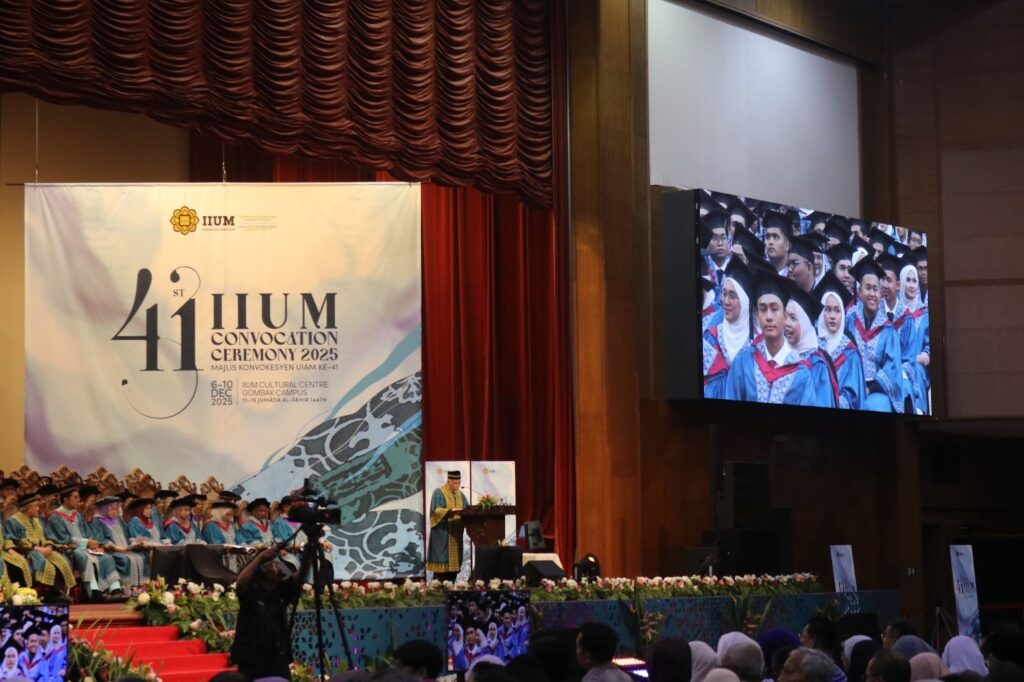
IIUM Rector, Professor Emeritus Datuk Dr. Osman Bakar, delivering his speech to KOE and KAED’s Graduates during the fifth session of the IIUM 41st Convocation Ceremony.

- Gombak Food Festival 3.0 to Champion Inclusive Entrepreneurship this Upcoming January - December 29, 2025
- POSSA’s Mini Taiwan Day Official Launch: First Cultural Collaboration with TECO - December 21, 2025
- Speech by IIUM Rector in the fifth session of 41st IIUM Convocation Ceremony - December 9, 2025