By, Md Helal Uddin
Recently, from August 23 to 28, a meaningful six-day 14th Graduate Conference was held in Istanbul under the auspices of the Istanbul Foundation for Science and Culture. The program aimed to bring together young researchers and graduate students from different academic backgrounds who are studying the Risale-i Nur Collection. It offered a supportive environment for participants to explore the ideas, methods, and spiritual insights of Risale-i Nur, while also encouraging research that stays true to its scholarly spirit and meets strong academic standards.
Said Nursi (1877–1960), widely known as Bediüzzaman (Wonder of the Age), was one of the most influential Muslim scholars of the modern era. His monumental work, the Risale-i Nur Collection, written in Turkish, offers a profound spiritual and intellectual commentary on the Qur’an. Through his writings, Nursi aimed to revive faith in an age marked by secularism and scientific progress. He not only emphasized the natural world but also urged readers to view the signs of the universe through the Qur’anic lens, where reason and heart work in harmony.
The conference was attended by participants from different countries across the world, including Malaysia, Bangladesh, India, Sri Lanka, Indonesia, and Nigeria, making the program truly global. Three PhD students from the International Institute of Islamic Thought and Civilization (ISTAC-IIUM), namely Akim Kazeem, Mohammad Arkam, and Helal Uddin, also took part in the event.
At the conference, leading experts on Said Nursi delivered their lectures on various topics and inspired participants with their insights. Professor Necati Aydin gave a presentation titled “How to Research Said Nursi as a Researcher.” He described Said Nursi as the greatest Islamic scholar of the contemporary era, who lived during a time when the Muslim Ummah, particularly in Turkey, was experiencing deep crises alongside the rise of science and secularism. Religion was being sidelined, yet Nursi worked to reconnect people with faith. Professor Aydin emphasized that to study Said Nursi properly, one must master Arabic and Turkish, know the Qur’an well, and gain solid knowledge of Nursi’s writings. Without this foundation, misunderstandings and misrepresentations could arise.
Another engaging presentation was delivered by Dr. Ahmet Subaşı, titled “Reading the Human Fitrah in the Name of the Lord Who Created: From Maqasid al-Shariah to Maqsad al-Haqiqi.” In his talk, Dr. Subaşı explored the concept of human fitrah (innate nature) and how it connects with divine purpose. He highlighted the shift from understanding Maqasid al-Shariah (the objectives of Islamic law) towards Maqsad al-Haqiqi (the ultimate purpose), emphasizing a holistic approach that links human nature with spiritual and ethical principles.
“Belief makes a man into a king; unbelief makes him an impotent beast,” said Said Nursi. This theme echoed in the lecture of Dr. Colin Turner, who spoke on “Why the Risale-i Nur?” He outlined six central pillars of Nursian thought: the most beautiful names, the mystery of the “human I,” self-referentiality versus other-indicativeness, causality and continuous creation, belief (faith) and submission (Islam), and the “closed doors” of creation. He stressed that these pillars are closely connected, forming a unified spiritual framework where each strengthens the others.
Another speaker, Dr. Mahshid Turner, delivered a lecture titled “How Do We Read the Book of Creation?” She discussed ideas such as seeing creation as a book or a gallery of signs, the ways these signs relate to human beings, and the insights the Qur’an provides about them. Dr. Turner highlighted how Said Nursi helps us interpret these signs, emphasizing that the heart of his theology is to observe and reflect on the physical world. She concluded that every being and every experience in life is a sign pointing to the Creator, as the Qur’an makes clear. Humans, she noted, have been equipped with reason, the heart (qalb), revelation, prophets, and the self (ana) to understand these signs. Creation itself is like a vast exhibition where the Names of God are engraved into every form, with all things glorifying Him. Quoting Said Nursi, she reminded that unbelief is not just denial but a crime against this reality, since the world is ultimately a testing ground where our task is to see beyond appearances and recognize divine truth.
Each lecture was followed by lively question-and-answer sessions, and participants also took part in daily activities such as group discussions and evening halaqas throughout the six-day conference. The organizers arranged guided visits to some of Istanbul’s most historic landmarks, including the Süleymaniye Mosque, Topkapı Palace, Hagia Sophia, Eyüp Sultan Mosque and the tomb of Abu Ayyub al-Ansari, the Bosphorus, Üsküdar, and the Blue Mosque. These visits allowed participants to experience the rich heritage of the Ottoman era and the spiritual atmosphere of the city. In addition, the group met with İhsan Kasım Salihi, the translator of Said Nursi’s works into Arabic, who shared insights on Nursi’s thought and offered valuable advice on studying his works.
On the final day of the conference, August 28, Said Yüce, Chairman of the Board of Trustees, delivered a lecture on the thought of Said Nursi and the activities of the Istanbul Foundation. Earlier that day, participants had also shared reflections on their purpose in joining the conference and their future plans for studying and spreading Nursi’s message. Moreover, participants wrote reflection papers on their proposals and presented them at the conference.
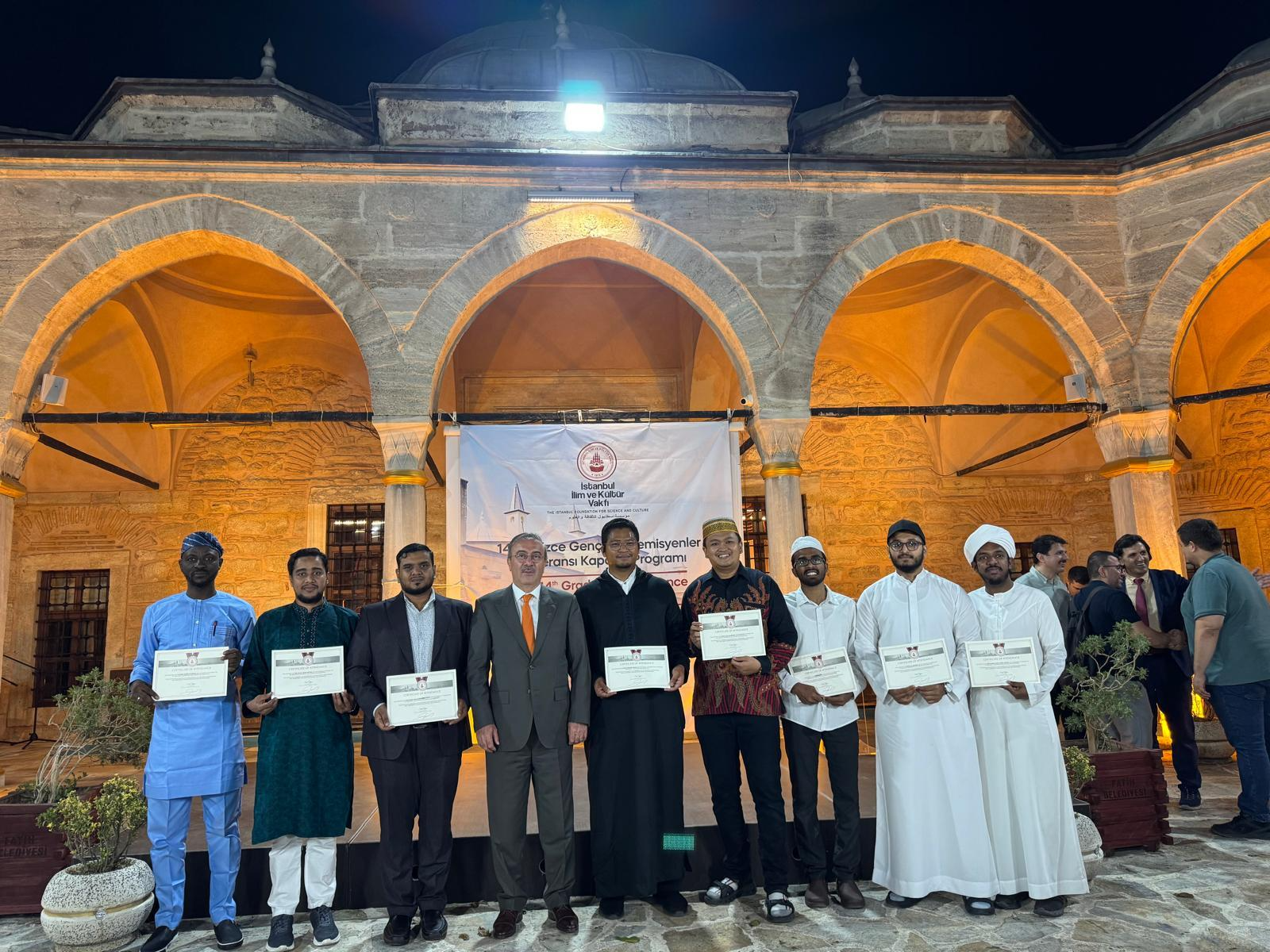
The closing ceremony, held at the Rüstempasha Madrasa and led by Dr. Ünal Akyüz with translation support from Tuğba Türkoğlu, was a memorable event attended by dignitaries connected to the Foundation. The Foundation’s Chairman delivered a meaningful address, after which participants shared reflections on the training they had received, the knowledge they gained, and their future plans to spread the teachings of Said Nursi, while also expressing heartfelt gratitude to the Foundation. The program concluded with the presentation of certificates and gifts to all participants.
Behind the scenes, several individuals worked tirelessly to ensure the success of the program. Tuğba Türkoğlu, the Foundation’s English Department and Western Relations Secretary, provided continuous support and language assistance from start to finish. Dr. Abdullah Santiago Salah, Secretary for International Relations and Policy Development, along with Dr. Salim, were also recognized for their dedicated contributions throughout the conference.
Md Helal Uddin, PhD Student in International Institute of Islamic Thought and Civilization (ISTAC-IIUM).***

- Knowledge Transfer on Stingless Beekeeping and Downstream Product to Empower the Communities - August 3, 2026
- Growing Together: How IIUM and Kebun Bandar Sungai Bunus Cultivate More Than Just Green Spaces - August 3, 2026
- Khalifah Nisa’: Reclaiming Women’s Role as Guardians of Creation - August 3, 2026