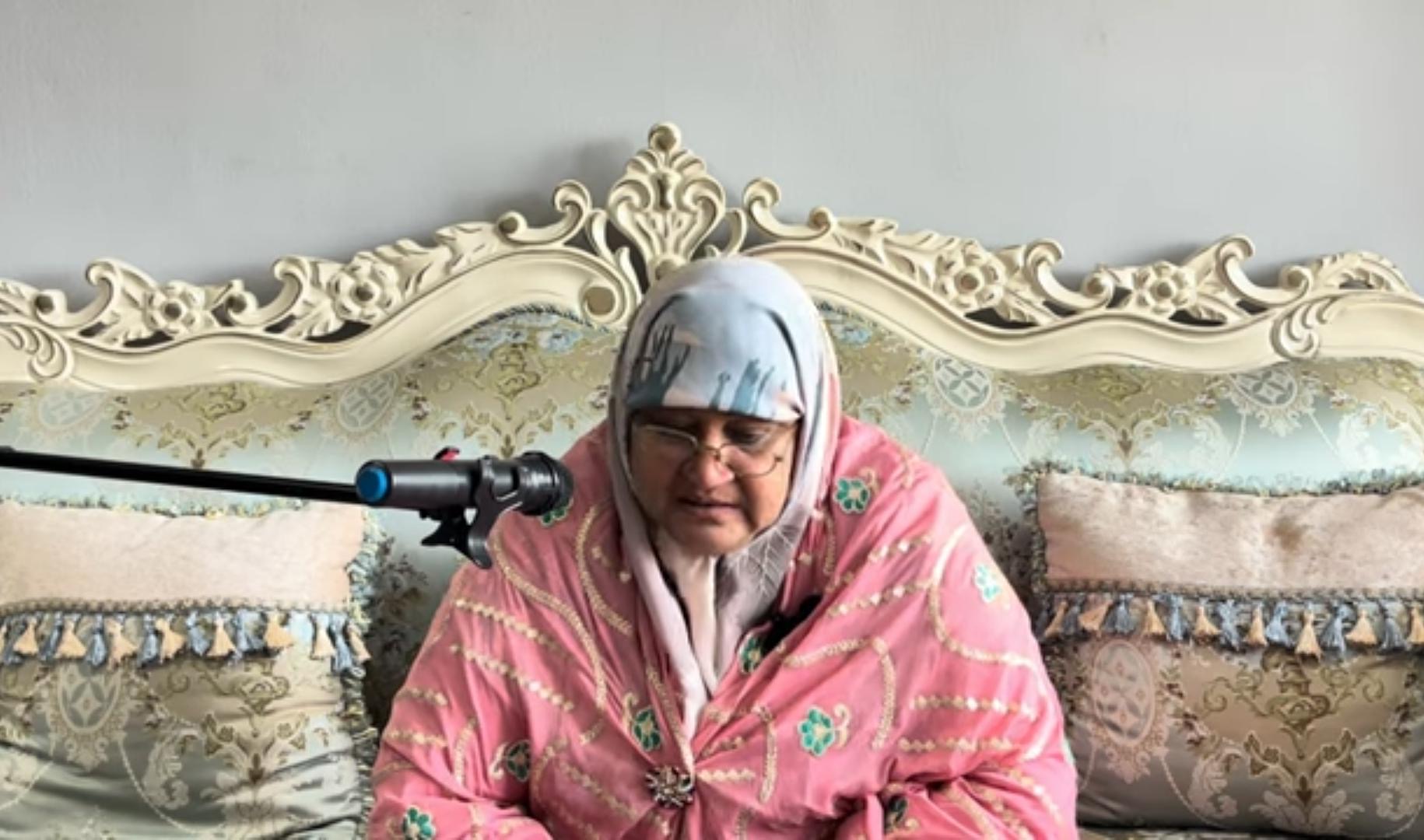
By, Daniya Afroz
Late Professor Zeenat Kausar—who passed away on 15th March 2026—was a distinguished scholar of International Islamic University Malaysia where she served as an Assistant Professor in the Department of Political Science from 1997 to 2006. She was the wife of Dr Mumtaz Ali, who currently serves as professor at IIUM. Her scholarship did not only encompass academic teachings but also significant contributions across various fields for the benefit the Muslim ummah. Her work focused on the critique of western civilization, gender studies—particularly feminism and Islamic political thought. She has authored more than 20 books, delivered more than 30 international conference papers, published dozens of peer reviewed journal articles globally, and received multiple awards for her research and academic contributions.
One of her scholarly contributions is the article titled “Women’s Empowerment in UN Documents neither a Safe Haven nor a Pandora’s Box: Need for A Holistic Perspective,” in which she examines the narrative set by UN to empower women.
Let me first begin with a question — Is women’s empowerment truly empowering women… or is it redefining them in ways we have not fully questioned?
At the very outset, Professor Zeenat makes her position clear. She does not reject women’s empowerment. She supports women’s development, dignity, and advancement. But her contribution lies in her critical examination of how this concept has been shaped — particularly by the United Nations. Her work focuses on the UN-promoted idea of women’s empowerment, especially since the 1995 Beijing Platform for Action. While this framework appears progressive, Professor Zeenat argues that it is not neutral — it is constructed and directed through a specific lens, known as the gender perspective.
According to the UN discourse, gender is not simply biological — it is seen as a social construct, where roles of men and women are defined by society rather than nature. At first, this may sound liberating. But Professor Zeenat urges us to look deeper.
She argues that this perspective goes beyond challenging harmful stereotypes. It begins to question even natural and foundational institutions such as:
• Heterosexual marriage
• The family structure
• And even reproduction within marriage
In this framework, all gender roles are often viewed as socially constructed — and therefore, something to be dismantled. This leads us to one of her strongest critiques:The UN-based concept of women’s empowerment is built on a framework that overemphasizes equal power-sharing in all spheres, ignores meaningful gender differences, and most critically, undermines institutions like religion and family.
Professor Zeenat highlights that in many UN documents, religion and family are subtly — and sometimes explicitly — portrayed as barriers to women’s empowerment.
But she asks a crucial question: Can empowerment truly exist without moral and social foundations? She argues that power alone is not enough. Power must be legitimized, guided, and restrained by institutions like religion and family. Without them, empowerment risks becoming directionless.
Another key contribution of her work is her critique of what she calls the “power-shifting model” of empowerment. Most modern theories define empowerment as the ability to make choices, to gain control, and to challenge power structures. While this is important, Professor Zeenat points out that this approach often becomes a “tit-for-tat” solution — simply shifting power from one group to another. But empowerment, she argues, should not just be about who holds power. It should be about how power is used, and within what moral limits. However, Professor Zeenat does not stop at criticizing the gender perspective.
She also introduces another extreme — what she calls the patriarchal perspective. This perspective, rooted in historical and cultural traditions, rigidly defines gender roles, placing women in subordinate positions both in family and society for e.g. restricting women’s participation in public affairs. Professor Zeenat firmly rejects this perspective as well.
And here lies the brilliance of her scholarship. She does not choose one extreme overthe other. Instead, she critiques both:
• The gender perspective, which dissolves structure in the name of equality,
• And the patriarchal perspective, which suppresses women in the name of tradition.
Between these two extremes, she calls for a middle path — a moderate, balanced, and holistic approach to women’s empowerment.
An approach that:
• Recognizes women’s rights and capabilities,
• Respects meaningful differences without turning them into inequalities,• And most importantly, restores the rightful place of religion and family as guiding institutions.
She beautifully cautions us that women’s empowerment should neither be seen as a
“Pandora’s box” — something dangerous to be feared, nor as a “perfect solution” — something blindly celebrated. Rather, it must be thoughtfully redefined.
In her concluding reflections, Professor Zeenat raises a powerful critique — about Western ethnocentrism, which imposes vision of viewing diverse cultures and civilizations through one lens. She reminds us of concepts like women’s empowerment cannot be defined by a single worldview. A truly meaningful framework must be inclusive of cultural, religious, and social realities.
In conclusion, Professor Zeenat’s contribution to academia is not just a critique —it is an intellectual intervention. She teaches us to question dominant narratives, avoid ideological extremes, and seek balance between progress and tradition with wisdom and integrity. Her work is a reminder that true empowerment is not just about gaining power — but about grounding it in purpose, ethics, and humanity.
All the works of Late Dr Zeenath Kausar reflected her lifelong commitment to meaningful scholarship. She was the best example of a Muslim woman — scholarly, intellectual, nurturing, and kind. May Allah (SWT) accept her efforts, forgive her shortcomings, and grant her the highest place in Jannah. May her knowledge continue to benefit others as ṣadaqah jāriyah, and may we carry forward her legacy with sincerity and purpose.***

- Knowledge Transfer on Stingless Beekeeping and Downstream Product to Empower the Communities - August 3, 2026
- Growing Together: How IIUM and Kebun Bandar Sungai Bunus Cultivate More Than Just Green Spaces - August 3, 2026
- Khalifah Nisa’: Reclaiming Women’s Role as Guardians of Creation - August 3, 2026