By, Dr. Mohammad Mohiuddin
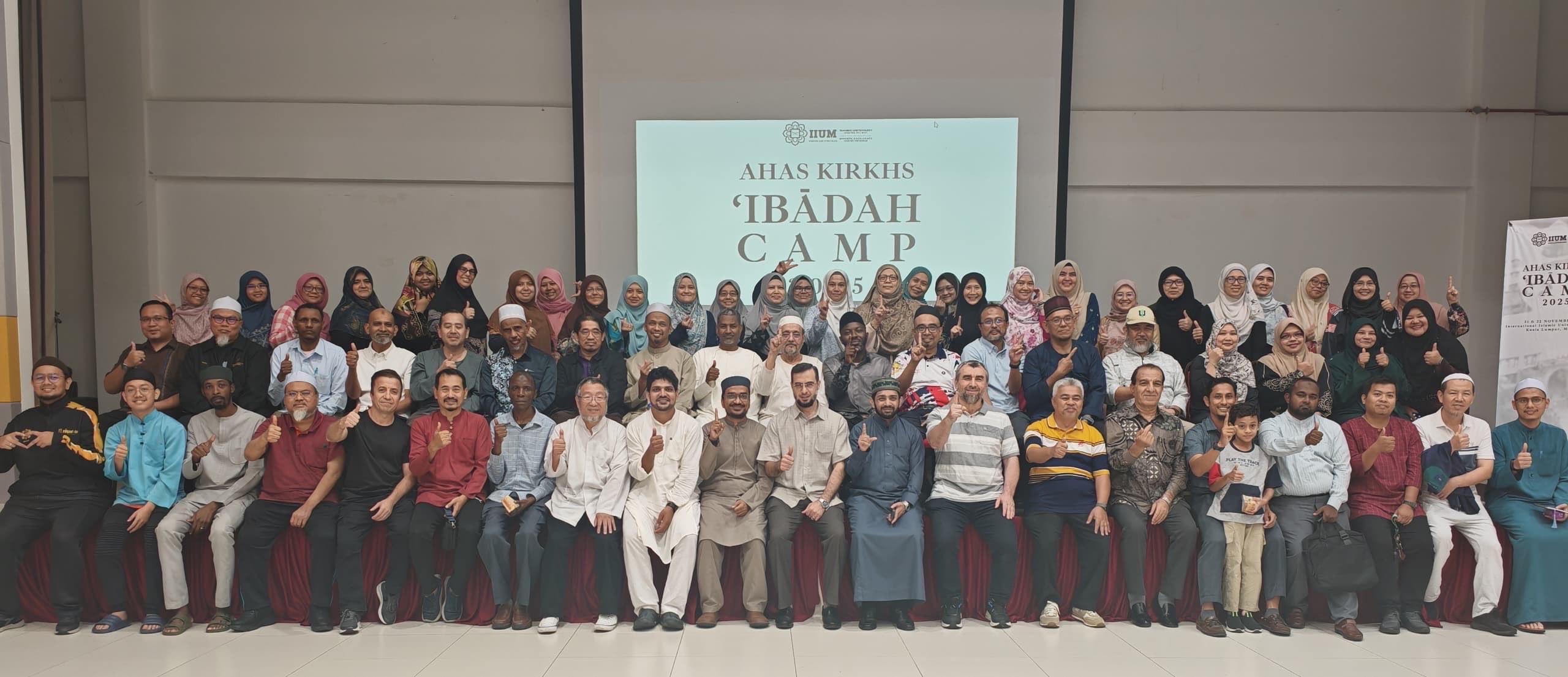
The AHAS KIRKHS ‘Ibādah Camp 2025, organised by the AbdulHamid AbuSulayman Kulliyyah of Islamic Revealed Knowledge and Human Sciences (AHAS KIRKHS), was held on 21–22 November 2025 with the central theme “Empowering the Role of Murabbi for a Resilient Ummatic Future.”
The two-day programme brought together academic and administrative staff to strengthen spiritual refinement, renew the spirit of brotherhood, and enhance the commitment to IIUM’s mission of nurturing holistic, principled, and future-ready generations.
Opening Ceremony: Rekindling the Spirit of Tarbiyah
The camp opened with welcoming remarks from the Dean of AHAS KIRKHS Prof. Dr. Hafiz Zakariyah, who emphasised the historical significance of Ibadah Camps as a signature IIUM tradition since its establishment. He reminded participants that every act of work at IIUM is inherently connected to ‘Ibādah, and that staff (academic and administrative) hold vital roles as Murabbis responsible for nurturing students with wisdom, compassion, and integrity.
The Dean called for deeper internalisation of ikhlas, amanah, and ukhuwah, as these values form the foundation of a transformative learning environment and a resilient Ummatic future.
Tadabbur Session: Cultivating Sincere Faith and Ihsan
After dinner and the ‘Ishā’ prayer, the participants attended a Tadabbur session delivered by Assoc. Prof. Dr. Abdulhamid Zaroum from the Department of Fiqh and Usul Al-Fiqh. He reflected on the moral depth of Surah al-Baqarah, verses 176 to 177, noting that these verses clearly distinguish between merely knowing the truth and embodying it through righteous action. He emphasised that true birr (righteousness) is not ritual formality or symbolic piety, but a holistic moral orientation grounded in faith, ethical conviction, compassion, and social responsibility.
Dr. Abdulhamid explained the Qur’anic concept of al-Birr, describing it as a holistic state of righteousness marked by strong belief in Allah, the Last Day, angels, the Book, and the Prophets paired with tangible actions such as giving charity, supporting others, being steadfast in hardship, and upholding trusts. He reminded participants that the Qur’an shapes a believer who prioritises the pleasure of Allah and the life of the Hereafter over temporary worldly attractions. These qualities, he explained, demonstrate that the Qur’an consistently ties spirituality to tangible ethical conduct, teaching that righteousness is not a claim but a lived moral disposition reflected in personal discipline, social ethics, and communal care. The session also reflected the higher levels of Iman and Taqwa that form the core of a Murabbi’s soul. Participants of the session shared deeply reflective personal insights, linking the verses to their work as educators and servants of the ummah.
The Tadabbur concluded with a closing reflection by Prof. Dr. Mohamed El Tahir El Mesawi, who emphasised the need for academics to translate Qur’anic wisdom into daily conduct, ethical scholarship, interpersonal compassion, and community-oriented service. He also highlighted practical techniques for attracting students’ attention and enhancing engagement in the classroom, stressing the importance of thoughtful communication, contextual examples, interactive learning strategies, and genuine care-qualities that help a Murabbi connect meaningfully with students and guide them with wisdom.
Qiyamullail: Experiencing the Night Worship
The spiritual portion of the camp continued with Qiyamullail, guided by Assoc. Prof. Dr. Nashwan Abdo Khaled from the Department of Quran and Sunnah Studies and Dr. Hassan Suleiman from the Department of Fiqh and Usul Al-Fiqh. In the stillness of the final third of the night, participants strengthened their connection with Allah, embodying the prophetic model of spiritual discipline; an essential trait of every Murabbi who leads through example.
Subuh Tazkirah: Sincerity, Trust, and the Muslim in the Workplace
After the Subuh prayer on 22 November, Assoc. Prof. Dr. Ismail bin Mamat from the Department of Usul al-Din, Comparative Religion and Philosophy delivered a tazkirah on sincerity and trustworthiness in professional life. He emphasised ikhlāṣ (sincerity) as the heart of all actions, and amānah (trust) as a sacred responsibility in fulfilling one’s duties as staff of a knowledge-based institution. He reminded the audience that work carried out within a university – when aligned with the principles of the Sharī‘ah – constitutes an act of ‘ibādah. Dr. Ismail also underscored that the acceptance of deeds rests on two essential conditions: a pure intention and adherence to divine guidance.
He further reflected on Surah al-Bayyinah (verse 7), noting that those who act with sincerity and consciousness of Allah are granted His pleasure and become genuine contributors to the well-being and advancement of the ummah.
Brisk Walk, Exercise, and Nature Reflection
Participants later joined a brisk walk and light exercise session, facilitated by Dr. Mohd Ikhwan bin Abdullah from the Department of Arabic Language and Literature and Dr. Belal Salhab from the Department of Fiqh and Usul Al-Fiqh. The activity incorporated a nature reflection, encouraging participants to reconnect with Allah’s signs in the natural environment. The activity not only promoted physical wellness, but also highlighted the Qur’anic worldview that observing nature enhances spiritual consciousness.
Invited Speech: The Murabbi as the Heart of Ummatic Transformation
An invited speech titled “Empowering the Roles of Murabbi for a Resilient Ummatic Future” was delivered by Prof. Dr. Akram Mohammed Zeki from the Kulliyyah of Information and Communication Technology, IIUM, in which he presented a comprehensive discourse on the historical and intellectual foundations of the Murabbi within Islamic tradition. He elaborated on the essential qualities that define an effective Murabbi and their multifaceted role in nurturing students spiritually, intellectually, emotionally, and socially.
Prof. Akram also drew on the pedagogical insights of classical Muslim scholars such as al-Ghazālī, Ibn al-Qayyim, al-Shāfi‘ī, Hamada, among others, and connected these to the legacy of IIUM luminaries Prof. Emeritus Datuk Dr. Abdul Hamid A. Abu Sulayman and Prof. Emeritus Tan Sri Dr. Mohd Kamal Hassan, whose pioneering ideas centred on spiritualising knowledge and positioning the educator as a Murabbi. He stressed that amid rapid technological, social, and moral transformations, nurturing students with prophetic wisdom, holistic character, and academic excellence is more urgent than ever.
Academic Forum: Aligning Scholarship, Leadership & Ummatic Mission
The final academic component of the camp was a forum titled “Developing Academics Towards Future Murabbis: Aligning Scholarship, Leadership and the Ummatic Mission.” It featured Asst. Prof. Dr. Mohammad Mohiuddin, Asst. Prof. Dr. Haeqal bin Ishak, and Dr. Asst. Prof. Fatimah Muhammad from the Department of Quran and Sunnah Studies, alongside Dr. Sohela Mustari from the Department of Sociology and Anthropology.
The discussion underscored the responsibility of academics to embody the role of Murabbi both inside and outside the classroom, modelling prophetic ethics in teaching, mentoring, leadership, and decision-making. The panelists emphasised the integration of Islamic values with contemporary scientific and technological developments, encouraging educators to extend their contributions beyond publication-driven outputs toward community-impact initiatives. They highlighted the need to develop students as holistic, ethical contributors to society and to ground academic life in the virtues of brotherhood, amānah, sincerity, compassion, humility, and wisdom. The forum was lively, reflective, and enriching, offering practical insights for both institutional advancement and the personal growth of academics striving to serve as future Murabbis.
Closing Remarks and Gratitude
The ‘Ibādah Camp 2025 concluded with closing remarks by Assoc. Prof. Dr. Tunku Mohar Tunku Mohd Mokhtar, Deputy Dean (Postgraduate and Responsible Research & Innovation), AHAS KIRKHS. He expressed gratitude to all speakers, panelists, staff, and the organising committee for ensuring the success of ‘Ibadah Camp 2025. He encouraged continued feedback and active involvement to further enhance future programmes.
A vote of thanks was delivered by the ‘Ibādah Camp Chairperson, Assoc. Prof. Dr. Saheed Abdullahi Busari, followed by a heartfelt du‘a recited by Asst. Prof. Dr. Belal Salhab, marking the conclusion of a spiritually nourishing and intellectually uplifting camp.
Conclusion
The AHAS KIRKHS ‘Ibādah Camp 2025 successfully reinforced the ethos of IIUM as a garden of knowledge and virtue. It revitalised the spirit of tarbiyah, strengthened staff unity, and re-anchored the university community to its mission of producing balanced, principled, and future-ready individuals. Above all, it reminded every participant that being a Murabbi is not merely a role; it is a lifelong amānah rooted in sincerity, service, and the prophetic tradition.***
Dr. Mohammad Mohiuddin is an Assistant Professor from the Department of Quran and Sunnah Studies, AHAS KIRKHS, IIUM.

- Knowledge Transfer on Stingless Beekeeping and Downstream Product to Empower the Communities - August 3, 2026
- Growing Together: How IIUM and Kebun Bandar Sungai Bunus Cultivate More Than Just Green Spaces - August 3, 2026
- Khalifah Nisa’: Reclaiming Women’s Role as Guardians of Creation - August 3, 2026