By, Mohd Abbas Abdul Razak
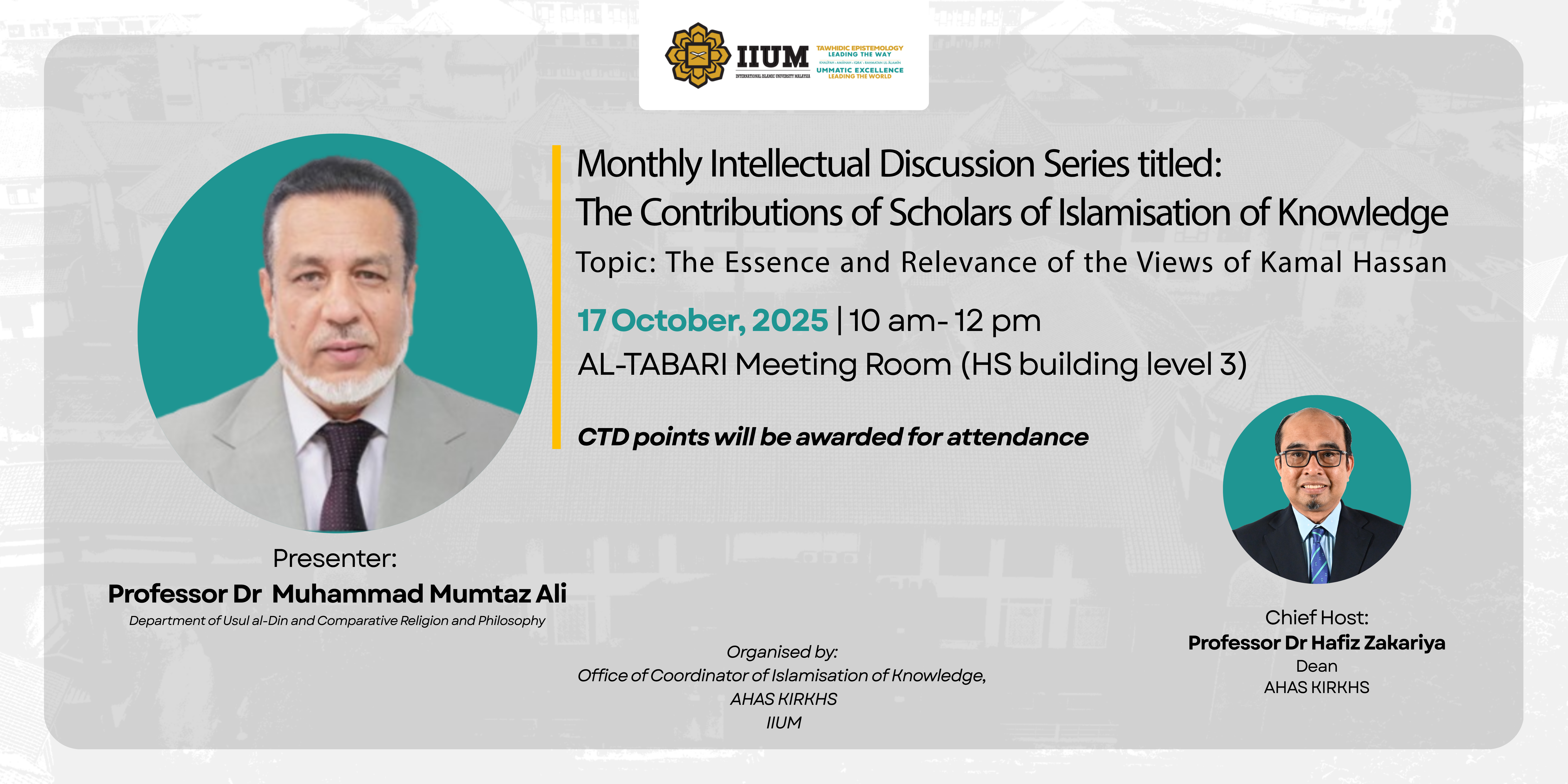
On Friday, 17th October 2025, an intellectual discourse was organized to honour the late Prof. Ulung Tan Sri Mohd Kamal Hassan. The event was hosted by the Office of the Coordinator of Islamization of Knowledge, AHAS KIRKHS, IIUM. The topic for that morning was “The Essence and Relevance of the Views of Kamal Hassan.” The presenter was none other than the distinguished Prof. Mohd Mumtaz Ali from the Department of Usul al-Din and Comparative Religion.
As a speaker, Prof. Mumtaz Ali has not only deeply immersed himself in the works of Kamal Hassan and interacted with him at the intellectual level, but he can also be regarded as one who had the privilege of dining and engaging with him in many other capacities.
Dr. Saheed Abdullahi Busari, a specialist in Islamic Jurisprudence, was entrusted by the Kulliyyah to serve as the chairperson for this intellectual banquet. The sharing sessions by the main speaker and other participants truly provided a feast of ideas and food for thought.
The Dean of the Kulliyyah, Prof. Dr. Hafiz Zakariya, who graced the occasion as the special guest, mentioned in his opening remarks that Prof. Mumtaz is a scholar worth listening to, as he is among those who know Prof. Kamal Hassan inside out.
Short Profile of Prof. Mumtaz Ali
Prof. Mumtaz Ali and his early intellectual life began in Hyderabad, India, the city that happens to be his hometown. Hyderabad, now known as the Silicon Valley of India, is where Mumtaz Ali was born. He completed his undergraduate studies at Osmania University and later pursued his Master’s and MPhil degrees in Political Science at Aligarh University. In 1986, he completed his PhD and moved to Malaysia in 1987 to begin his teaching career.
Upon his arrival in Malaysia, he was offered a teaching position at the Department of Usul al-Din and Comparative Religion, International Islamic University Malaysia (IIUM). At Usul al-Din, he started his teaching career with a course on the History of Modern Islamic Thought. Over time, his teaching interests expanded to include Developmental Studies, Modernization, Epistemological and Methodological Studies, Critical Thinking, Philosophy of Science, and Modernity. At present, he is one of the most popular lecturers on the Islamization of Knowledge for postgraduate students.
His teaching career at IIUM spans four decades. Mumtaz Ali has authored several bestselling reference books, including Issues in Islamization of Human Knowledge: Civilization Building Discourse of Contemporary Muslim Thinkers, The Islamization of Modern Science and Its Philosophy, and Islamic Research: Theory, Methodology and Thesis Writing – A Milestone for Sustainable Development.
Besides the above, his other literary contributions to the Muslim Ummah will be Islam and the Western Philosophy of Knowledge: Reflections on Some Aspects; The Philosophy of Science: Western and Islamic Perspectives on Certain Aspects; Islamic Critical Thinking; The Failure of Modernity and the Development of Contemporary Islamic Revivalist Discourse: Towards an Alternative Civilizational Development; The History and Philosophy of Islamization of Knowledge: A Preliminary Study of Pioneer’s Thought; The Clash of Civilizations or Civilizational Peaceful
In recognition of his scholarship and contributions to academic writing, the Malaysian government awarded him the National Book Award in 2014, 2016, and 2023. To this day, he continues to be recognized as one of the distinguished scholars at IIUM.
Kamal Hassan’s Intellectual Legacy
Kamal Hassan made remarkable contributions to the university’s development and reputation, as well as to the grooming of young academics—preparing them to become the next echelon of Islamic intelligentsia to carry forward what he had initiated.
In his presentation, Prof. Mumtaz emphasized that the idea of establishing the first Islamic university in Malaysia was entrusted to Kamal Hassan, who at that time was a young and promising scholar. Analogically, he was described as a “new star on the horizon.” This formidable task was successfully accomplished by Kamal Hassan, and his tireless efforts bore fruit with the establishment of IIUM in 1983.
Unlike many existing Islamic universities in the Muslim world, Prof. Kamal Hassan envisioned IIUM as an institution with its own distinctive features. At IIUM, knowledge in all fields is taught across various Kulliyyahs from a dual perspective—both Western and Islamic. This approach offered students the opportunity to understand and evaluate ideas through the lenses of both traditions. At that time, such an approach was something new and innovative. Today, however, many Islamic institutions of higher learning in the Muslim world have adopted and replicated the model pioneered by IIUM.
During his presentation, Prof. Mumtaz drew the audience’s attention to the fact that he has written at great length about Kamal Hassan in his recently published work titled “Mohd Kamal Hassan: The Pearl of the Malay World.” To Prof Mumtaz, Kamal Hassan is the intellectual architect of IIUM. Prof. Mumtaz reiterated again and again in his presentation that Kamal Hassan inherited and continued the good works done by his predecessors, particularly the one before him, the late Prof. Emeritus Abdul Hamid Ahmad AbuSulayman (1936-2021).
Kamal Hassan, who was well-acquainted with the ideas of Syed Muhammad Naquib al-Attas (1931–present) and Ismail Raji al-Faruqi (1921–1986) on the Islamization of Knowledge, made it one of the key agendas of IIUM. He believed that the chaos and derailment from the true philosophy of education in the Muslim world occurred as a result of Western colonization of Muslim lands.
Through the concept of Islamization of Knowledge, Kamal Hassan sought to instill in the minds of IIUM students the understanding that, unlike the Western educational perspective—which holds that knowledge and science are value-free—the Islamic concept of knowledge is inherently value-laden and God-centred. Islamization of Knowledge is rooted in the Islamic Tawhidic epistemology, which affirms that God is the ultimate source of all knowledge. Therefore, the pursuit of knowledge in Islam is a sacred obligation incumbent upon all Muslims, both male and female.
Islamization of Knowledge calls for removing all the harmful elements found in Western educational philosophies and theories. The next step in this process is to include Islamic values and related knowledge found in the Holy Qur’an, the Sunnah, and the Islamic heritage.
Unlike Western knowledge, which focuses mainly on life in this world, Islamization aims for the betterment of life both in this world and in the hereafter. Furthermore, to be a good Khalifah of Allah (vicegerent of God) and to carry out one’s duties well, a person must be properly equipped with knowledge.
Besides emphasizing the Islamization of Knowledge, Prof. Mumtaz mentioned that Kamal Hassan also stressed the importance of the Islamization of the Self. In Kamal Hassan’s view, problems such as corruption, chaos, white-collar crime, economic mismanagement, war, terrorism, and other human conflicts happen because people fail to Islamize themselves.
Through the Islamization of the Self, Muslims can purify their intentions and actions for the sole purpose of gaining the pleasure of Allah. A true believer also relates his or her life to the honour and progress of the Muslim Ummah. Through this process, one renews his or her commitment to Allah and His Prophet (SAW). Performing one’s duties and responsibilities is then seen as a form of ibadah (worship).
In a way, Islamizing the Self also means tazkiyat al-nafs—the purification of the heart from evil thoughts and desires. By doing this, a person becomes a sincere servant of Allah, selfless and ready to work for the betterment of the Muslim Ummah and humanity as a whole.
Take-Home Message from Prof. Mumtaz
Prof. Mumtaz, who spoke for more than an hour, spent an additional half hour engaging the audience in a question-and-answer session. During this session, both academics and students took the opportunity to seek clarification on the terminology and ideas discussed in his lecture.
As a take-home message, Prof. Mumtaz called for more research on Kamal Hassan’s views on education and on how these ideas can help bring about transformational change in the Muslim world. He also emphasized the importance of documenting Kamal Hassan’s life story—his struggles, achievements, and contributions—so that it becomes a source of knowledge and inspiration for all students at IIUM.
“The views expressed herein are those of Dr. Mohd Abbas Abdul Razak of the Department of Fundamental and Interdisciplinary Studies, AHAS KIRKHS, IIUM, and do not necessarily reflect the views of IIUM-Today.”***

- Knowledge Transfer on Stingless Beekeeping and Downstream Product to Empower the Communities - August 3, 2026
- Growing Together: How IIUM and Kebun Bandar Sungai Bunus Cultivate More Than Just Green Spaces - August 3, 2026
- Khalifah Nisa’: Reclaiming Women’s Role as Guardians of Creation - August 3, 2026