By, Dr. Adibah Amir
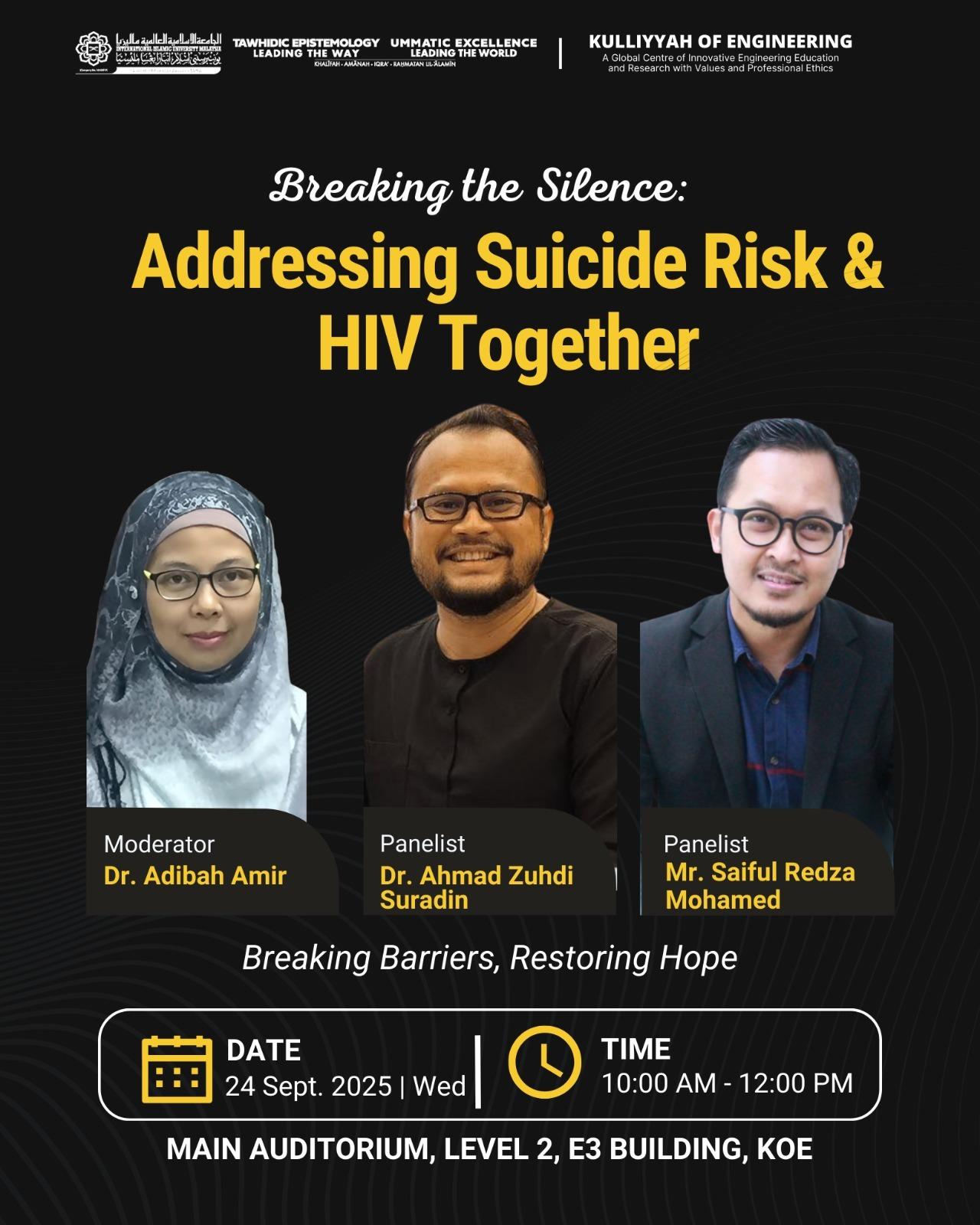
The Kulliyyah of Engineering (KOE), International Islamic University Malaysia (IIUM), held an insightful forum titled “Addressing Suicide Risk and HIV Together” at the Main Auditorium on 24th of September 2025, bringing attention to two critical public health issues, peeling back the layers of stigma that make discussions on suicide and HIV so often shrouded in silence.
Bringing together both medical and psychological perspectives, the forum explored how physical illness and emotional distress intertwine in ways that test the human spirit. The session featured two distinguished speakers, Dr. Ahmad Zuhdi bin Suradin from the IIUM Sejahtera Clinic and Mr. Saiful Redza bin Mohamed from the IIUM Counselling and Career Services Centre, both deeply committed to nurturing holistic wellbeing within the IIUM community.
Dr. Ahmad Zuhdi began by addressing what he called “the double burden” faced by individuals living with HIV. Beyond the physical challenges of the illness, they often carry invisible emotional wounds, rejection, guilt, and fear of judgment.
Many still assume that HIV and AIDS are the same, when in fact they are not. HIV is the virus, while AIDS is the advanced stage of the infection that occurs if HIV is left untreated. With early testing, consistent treatment, and proper support, people living with HIV can lead long, healthy lives. When their viral load is well controlled, the risk of transmission becomes almost zero, allowing them to build families, raise children, and look forward to a future like anyone else.
Dr. Ahmad Zuhdi also emphasized that Malaysia remains steadfast in its mission to end AIDS by 2030, a goal that depends as much on compassion as it does on medicine.
Picking up the discussion, Mr. Saiful Redza invited the audience to understand the silent struggles of those dealing with suicidal thoughts. His tone was calm yet profound.
“Many people don’t actually want to die,” he said softly. “They just want the pain to stop.”
He explained that self-harm often signals difficulty in coping, a cry for help rather than a desire for death. “At that moment, what they need most isn’t advice,” he added. “It’s to be heard. Recognising these early signs can save a life.”
Mr. Saiful urged the community to replace judgment with empathy. “Sometimes,” he said, “listening is more powerful than medicine.”
Both panellists reminded the audience that awareness must lead to action. When someone we know, friend, peer, or family member, may be at risk of HIV or showing signs of emotional distress, the first response should be empathy, not fear or judgment. They emphasized that intervention begins with connection, reaching out, listening, and offering support. It’s not about fixing someone’s problem, but about making sure they don’t have to face it alone.
Dr. Ahmad Zuhdi advised that early testing and counselling are the first steps. “Encourage them to seek medical help immediately,” he said. “At IIUM Sejahtera Clinic, all screenings are confidential and handled with compassion. Sometimes, knowing they won’t be judged is enough to help them take that first step.”
Meanwhile, Mr. Saiful Redza highlighted the importance of emotional support. “When a person feels cornered by shame or fear, our role is to be present, not to interrogate, but to accompany,” he explained. “Ask how they’re feeling, listen without interrupting, and gently connect them to professionals, whether at the IIUM Counselling Centre, MENTARI unit Hospital Selayang, or trusted healthcare providers.
The forum served as a timely reminder that compassion and awareness must go hand in hand. Both issues, though often clouded by stigma, demand understanding, empathy, and proactive care.
Dr. Adibah Bt. Amir is an Assistant Professor from the Department of Manufacturing and Materials Engineering, Kulliyyah of Engineering, International Islamic University Malaysia.***

- Knowledge Transfer on Stingless Beekeeping and Downstream Product to Empower the Communities - August 3, 2026
- Growing Together: How IIUM and Kebun Bandar Sungai Bunus Cultivate More Than Just Green Spaces - August 3, 2026
- Khalifah Nisa’: Reclaiming Women’s Role as Guardians of Creation - August 3, 2026