By, Nur Anis Afrina Muhamad Husaini and Nur Athirah Mohd Fatihi
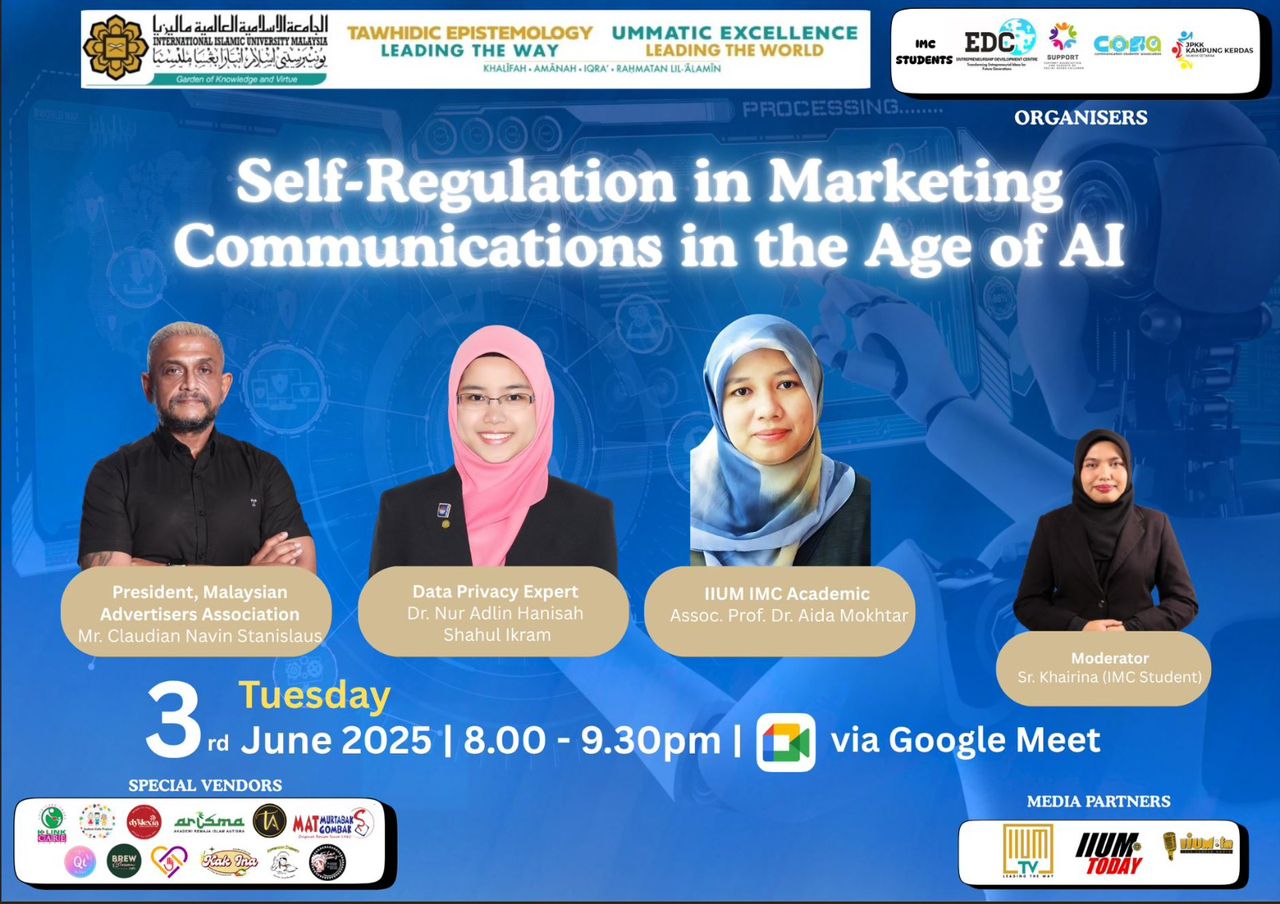
GOMBAK, 5 JUNE 2025: These days, artificial intelligence (AI) is popping up everywhere. It has become a game changer in integrated marketing communication (IMC). From writing captions to analyzing
data, AI offers countless tools. But the real question isn’t what it can do, but how we choose
to use it. As President of Malaysian Advertisers Association (MAA), Claudian Navin Stanislaus shared in the virtual forum, Self-Regulation in Marketing Communications in the Age of AI on 3 June 2025, “It’s not about the tools, it’s about the person behind it.”
Think like a knife which is sharp, effective and versatile. In the right hands, it can prepare
nourishing meals. But in the wrong hands, it can cause harm. The same principle applies to
AI in marketing. It has huge potential. Its impact entirely depends on the intent and creativity
of the communication marketer.
So, what is the secret to mastering AI in communication strategies? It starts with
understanding that AI is not here to replace marketing communicator but see it as a helper. The best tip is to treat AI as a smart partner. It can make your work faster and smarter, but it still needs your
ideas, your creativity and personalized content at scale. When used wisely and with the right
mindset, it can connect you with your audience in ways you never imagine. But without clear
intent and ethical use, it risks becoming just another trend which can be misunderstood and
misused.
The AI effect in action: AI speed up the marketing game
The fact is no one enjoys spending hours stuck on boring and repetitive tasks. So the good
news is that AI has totally changed the game in marketing communication. Tasks that used to
take hours like writing reports, analyzing audience data or planning content can now be done
just in minutes and just a few clicks. It’s like having an extra team member who works fast
and never gets tired! Even better, you don’t need to change everything about the way you
work. It just brings AI into your routine to make life easier.
But here’s a little reminder. Just because AI makes things faster doesn’t mean we can sit back
and let it do all the work. AI is a smart assistant, not a “cheat code”. It’s still up to you to
bring the creativity, the strategy and the human touch.
Think of AI as a time saver that helps you focus on what really matters and not a shortcut to
cut corners. Not just that, what AI brings to the IMC table is it’s changing how entire marketing teams
work. With the help of smart tools, companies can now create, plan, and deliver messages
much faster than ever before.
In fact, Claudian Navin shared a real example of reducing copywriters, “…from 15 to 6 copywriters,” with the use of AI. That’s how much one company manages to streamline their content team after integrating AI into their workflow. It’s not about replacing people. But about using tools that make things
simpler, faster and more focused.
Thanks to AI, communication marketers can now plan their campaigns smarter from the start.
You can set the message, pick your target audience and let AI handle the boring stuff like
writing drafts or testing ideas. It’s like having a super smart helper that knows what you want.
This means less time stuck on routine work, and more time to focus on other big ideas.
Using AI with heart: Practicing self-regulation in AI-driven marketing.
Marketing communicators can be responsible in using AI-generated thoughtfully. This
involves practicing self-regulation that means not relying blindly on AI, but instead actively
adjusting and improving the output.
As Claudian Navin explained, “AI is a tool, it is a powerful tool, but it’s still a tool”. Its
output depends on how we use it. He also said, “ChatGPT predominant data sets are built overseas, so it may be nuanced and skewed towards a western scenario.” Since ChatGPT is trained mostly on western data, which means responses may not fully reflect local cultures or contexts. That’s why self-regulation is crucial.
With AI doing so much for communication marketers today, it’s easy to get carried away. But
just because the technology is powerful doesn’t mean we should use it without limits. That’s
where self regulation comes in. It’s all about setting your boundaries and using AI with a
clear purpose. As Claudian Navin wisely said,
“There were no regulations in those days. Now, you cannot have that, but you can tune
yourself within a space and say, these lines I will not cross, but I can play within. Just like a
colour. It’s not just about black and white, sometimes it can be grey.”
In other words, it’s up to you to know where to draw the line. You don’t have to follow a
strict rulebook, but you do need to stay true to your values. Don’t blindly use AI to create no
value content or misleading messages just because it’s easy. Instead, ask yourself, “is this
right? Does this reflect who we are as a brand? Can this have an impact on society ?”
Use AI as a helpful partner, not a shortcut and make sure that the message still has heart,
honesty and a human touch. That’s how great communication marketers stay trusted and
ahead.
Responsibility in Marketing: What Tomorrow’s Communicators Must Learn Today
In this digital era, future marketing communicators have a big responsibility. With the
existence of the powerful tool, Artificial Intelligence (AI), it’s easy to get caught up in using
the latest trends just to stay relevant. But being a responsible marketing communicator means
more than following trends, it means using technology wisely, ethically, and with purpose.
As reminded by Claudian Navin, “Just because we can, doesn’t mean we need to”
meaning here that, just because AI offers an innovative or eye-catching solution, it doesn’t
automatically mean that it’s the right choice for every campaign or every audience.
Responsible communicators must ask themselves whether the tool is beneficial or if it just
simply acts as a shortcut. By thinking critically, the future marketers can ensure that their
work not only keeps up with the times, but also builds trust and delivers meaningful impact.
Another important fundamental that he highlighted, “Do unto others what you want others to do unto you.”
He further explained, “ So, if you don’t want them to do it to you, you as a consumer, you don’t
want to be cheated, you don’t want to be taken for a ride, you don’t want AI or any tools to be
used to manipulate you, your life, or your lovely ones, then, don’t do it to them as well.”
This reminder urges future communicators to maintain empathy and integrity in every
decision. By treating consumers using the same fairness and respect that they expect,
marketing communicators can build meaningful relationships and shape a more ethical future for the industry.
In the end, AI in Integrated Marketing Communication is like a paintbrush. It is powerful in
the right hands, but only as meaningful as the artist behind it. When it is used with creativity
and integrity, it doesn’t just impress, but it creates messages that genuinely resonate.
The forum was held in conjunction with the Gombak Food Festival 2.0 organised by COMM3315: Integrated Marketing Communication students from 3 to 4 June 2025 at IIUM Gombak.***

- Kukii: Where Sincerity Meets Sweetness atGombak Food Festival 2.0 - August 20, 2025
- Flavour of Gombak in GFF2.0: Empowering Kampung Kerdas Entrepeneurs - August 20, 2025
- Hidden Gem in Selangor: Sandwich Awesome Café - August 20, 2025